

What Is the Micro-Deval Test and How Does It Measure Aggregate Durability?
Published on:
October 27, 2026
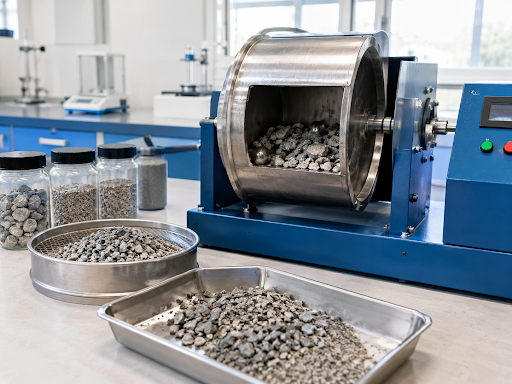
The Micro-Deval test is a lab method that checks how well aggregate stands up to wet abrasion. A sample is tumbled in a rotating jar with water and small steel balls, then weighed again to see how much material wore away. A lower loss percentage generally points to more durable stone, and aggregate hardness is another factor that affects how well construction materials stand up to wear and pressure.
At Western Materials, durability is something we take seriously, because stone that crumbles early turns into a repair bill for you. In this blog, we’ll cover how the test works, how to read the results, and where it fits next to other durability checks.
Why Durability Needs Its Own Test
Despite its appearance, a pile of gravel may have hidden weaknesses. This is because there are some rocks that behave well in dry conditions, but when water enters, they become soft and begin to fall apart. This is what happens underneath a road, driveway, or trench after several rainy seasons.
Size tests indicate the distribution of particle sizes, while sieve analysis helps determine aggregate gradation without showing how well the material will resist long-term wear. They do not indicate how they will behave after years of use by people and exposure to natural conditions such as rain. The missing information explains the necessity for a durability test, Micro-Deval being among the most reputable.
How the Micro-Deval Test Works
The test follows ASTM D6928 for coarse aggregate and AASHTO T327, with a related method for fine aggregate. That’s pretty much the basic concept: replicate years of wear and tear in just a few hours.
A laboratory begins with around 1,500 grams of cleaned and oven-dried aggregates that are generally sized in accordance with standard sizing parameters. The sample gets soaked in water for at least an hour before being put into use. Moisture can affect aggregate behaviour during testing, much like the SSD condition in aggregate testing influences how moisture is accounted for in concrete mix calculations.
Then, the soaked sample gets placed in a stainless steel jar together with two liters of water and a charge of steel balls weighing 5,000 grams in total. The jar spins at a rate of roughly 100 revolutions per minute, depending on the size of the stone used, for 75 to 105 minutes. While the steel balls crush the stone inside the jar, water is responsible for carrying away the fines.
Finally, when the jar is stopped, its contents get washed through a sieve of the No. 16 size with a 1.18 mm aperture. All that’s left of the stone is washed and weighed.
Calculating Micro-Deval Abrasion Loss
The math is refreshingly easy. Take the original dry weight, subtract the weight that stayed on the sieve, divide by the original weight, and multiply by 100. The answer is the Micro-Deval abrasion loss, shown as a percentage.
Say you start with 1,500 grams and 1,260 grams remain. You lost 240 grams, which is 16 percent. That number is the headline result, and it’s what specifications usually refer to.
Lower is better. A loss of 5 percent suggests very hard, sound stone. A loss of 25 or 30 percent suggests material that will break down fast. Limits depend on the agency and the job, though many road specs cap the figure somewhere in the teens or low twenties, so always check your own project requirements.
What Wet Abrasion Resistance Really Tells You
Wet abrasion resistance is the stone’s ability to keep its shape and size while being scrubbed in water. Different rock types can react differently to moisture and abrasion, which is why aggregate mineralogy matters when assessing the durability and performance of construction materials.
The Micro-Deval catches those problem stones. It also has a good track record of matching how aggregate performs in the field, which is why many highway agencies now prefer it. Some of them also fold results like this into an aggregate durability index, a rating used to approve or reject a material source.
Aggregate Particle Degradation in the Real World
Aggregate particle degradation is what happens when stones slowly break into smaller pieces and fines. In a road base, that means the material changes under traffic, packs differently, and often holds more water than it should. In concrete or asphalt, soft particles can weaken the finished product from within.
You can spot the early signs on site: more dust than expected, a base that settles unevenly, or stone that looks rounded and chipped after compaction. A low Micro-Deval loss makes those problems far less likely, because the stone was already proven to resist wear.
Need hard, weather-tested sand and gravel for your South Bay project?
Get a Quote for Your Project
Polishing and Degradation Resistance on Roads
Surface layers face a different challenge. Tires constantly rub against the stone, and over time some aggregates wear smooth and lose their grip. Good polishing and degradation resistance keeps the surface rough enough for safe braking, even in wet weather.
To be clear, the Micro-Deval isn’t a dedicated polish test, since separate methods exist for that. But it gives a strong early hint. A stone that wears down quickly in the jar is rarely the stone you want in a surface course.
Micro-Deval vs. Los Angeles Abrasion
People often ask how this compares with the Los Angeles abrasion test. The LA test is dry. It tumbles stone with heavy steel spheres and measures breakage from impact, one of the properties considered when assessing construction rock quality.
It’s quick and widely known, but it tends to reward hard, brittle rock and can miss stone that fails in the presence of water.
The Micro-Deval uses a gentler, wetter process that is closer to real weathering. Many projects use both, since they reveal different weaknesses.
Getting Reliable Results
Even the best test can’t fix a poor sample. Material should be taken from several points in the stockpile, not just the top, and it must truly represent what will be delivered. Keep the water level, ball charge, and run time exactly as the standard requires, because small changes can shift the result.
Conclusion
The Micro-Deval test gives you a clear, practical answer to a question that sieve analysis can’t: will this stone last? Once you understand the loss percentage, you can compare materials with confidence and avoid weak stone before it goes into the ground.
If you’re looking for sand and gravel in South Bay that has been selected with durability in mind, Western Materials is here to help. Share your project details, ask for test data, and we’ll point you toward material that holds up.
Frequently Asked Questions
1. What does the Micro-Deval test measure?
It measures how much aggregate wears away when tumbled with water and steel balls. The result shows the stone’s resistance to wet abrasion and weathering. A low percentage means durable material, while a high percentage warns that the stone may break down under traffic, moisture, and repeated stress.
2. What is a good Micro-Deval abrasion loss value?
The lower the figure, the better. Any score under 10 percent would be regarded as highly durable, whereas figures over 20 to 25 percent would likely be cause for worry. The allowable range varies between agencies and types of projects, so check your score against the specification of your project.
3. How is the Micro-Deval test different from the Los Angeles abrasion test?
The Los Angeles method uses dry testing and emphasizes the breaking effects, employing heavy steel balls. On the other hand, the Micro-Deval test is carried out with wet conditions and employs small steel balls to simulate erosion and abrasion. Water softens certain rocks, and hence the Micro-Deval method often exposes weaknesses not seen by the dry test.
4. Why is the aggregate soaked before testing?
This process allows the water to penetrate into the pores of the stone, similar to how rainwater would do in the field. Fragile or porous particles will soften and become vulnerable to erosion. If this process is omitted, it would conceal these fragilities and make the bad aggregate appear as good.
5. Can the Micro-Deval test be used on fine aggregate?
Yes. There is another test method for sand and other fine aggregates, which is designated by the code ASTM D7428. Different sample size, ball charge, and duration of grinding are used for this test, but the principle is identical to that described above.

Materials management and founders
have produced and supplied high quality
sand and gravel to contractors &
aggregate users across California.


