.png)

What Is SSD Condition and Why Does It Matter in Aggregate Testing?
Published on:
October 15, 2026
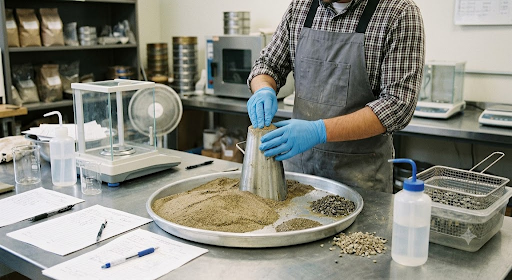
SSD condition in aggregates means a particle has soaked up all the water its pores can hold, yet its outer surface is dry to the touch. Think of a sponge that's been fully soaked and then wiped down on the outside. It feels dry, but it's still full. That state matters in aggregate testing because it gives labs a fixed point to measure specific gravity and absorption from, and it gives mix designers a clean baseline for the water in a batch.
At Western Materials, we get plenty of questions about moisture in sand and gravel, so this post goes through it step by step. We shall learn about the concept of saturated surface-dry condition and its position in relation to other moisture conditions, along with distinguishing between aggregate moisture content and absorption. Then we look at methods for determining specific gravity, effective water-cement ratio, and a couple of ways you can test moisture yourself.
What Is SSD Condition in Aggregates?
Each particle and each grain of sand contains small holes that absorb moisture, and a saturated specimen will have water-filled holes. Take it out, dry the exterior until there’s no shine left, and you have an aggregate in SSD state: completely dry from the outside and fully saturated on the inside.
Testing was done to this standard, since a bone-dry rock continues to absorb moisture, while a wet one takes extra moisture outside. SSD state can be reproduced anywhere, and therefore the results can be comparable between different labs.
Where Does SSD Sit Among the Four Moisture States?
Aggregate on a real job can be in one of four conditions, and it helps to see them side by side.
Oven-Dry and Air-Dry
Oven-dried aggregate has undergone heating to the point that all traces of moisture have been removed; this is where testing of absorption begins. On the other hand, air-dry stone feels dry but still contains some moisture hidden in its pores.
Saturated Surface-Dry and Wet
SSD falls between them: pores are full, but the surface is dry; hence the stone neither absorbs anything nor contributes anything to the concrete mixture. Wet aggregates represent the stockpile you encounter after a wet week where the pores are filled, as well as a film of water covering each particle.
Need sand that's tested for a concrete or mortar job?
Request a Quote
Why Does SSD Condition Matter in Aggregate Testing?
The first is specific gravity. This is the ratio of the density of a particle compared to water. When it is done on an SSD basis, the pores filled with water are taken as part of the total volume of the particle. Designers of mixtures can use this number to change the weight of material into volume. The testing procedure used for specific gravity includes ASTM C-127 and C-128, which appear on the list of tests used for sand and gravel.
Absorption is the second characteristic measured from the same baseline, and it matters because aggregate absorption in concrete mix design affects how much water the aggregate takes up before the cement paste can use it. It is the quantity of water absorbed before becoming SSD. This is expressed as a percentage of its oven-dry mass. Subtract the mass of the oven-dry from SSD, divide the difference by oven-dry mass, and then multiply by 100.
How Does SSD Condition Affect the Effective Water-to-Cement Ratio?
The effective water-to-cement ratio only counts water that's actually available to the cement paste. When the aggregate is wetter than SSD, the surface water adds itself to whatever you batched.The ratio goes up, which can reduce compressive strength and increase porosity and shrinkage cracking. Since excess water is one factor that can affect concrete durability, the reasons for concrete cracking are worth considering when controlling moisture during batching. When it's drier than an SSD, the stone does the reverse. It pulls water out of the paste to fill its own pores, so the mix can stiffen faster than planned.
Picture a 20-ton load of sand at 7 percent moisture. Roughly 1.4 tons of that weight is water, so you're getting less sand than the ticket suggests, and some of that water is going straight into your mix.
Questions about moisture or lab reports for your project?
Give our team a call
How Can You Check Aggregate Moisture Content on Site?
Calibrated boxes give a quick volumetric check, though loose density shifts from pile to pile. For a number you can trust, use the gravimetric method. Weigh a damp sample, dry it until the weight stops changing, then take the wet weight minus the dry weight, divide by the dry weight, and multiply by 100. A hot plate, a field stove, or even a microwave can do the drying when you need a fast answer.
With that figure in hand, subtract the aggregate's absorption capacity to estimate the free moisture that affects the mix. Accurate moisture readings also help when calculating sand and gravel quantities for large projects, as the moisture in a load can affect its actual dry material content.
Wrapping Up
SSD condition in aggregates never shows in a finished slab, but it has a hand in every number that goes into making one. If you need sand and gravel in San Jose, Western Materials supplies projects across Santa Clara County, including Santa Clara, Cupertino, Los Gatos and Sunnyvale, with bulk delivery to your job site or pickup at the yard.
Frequently Asked Questions
1. What is the SSD condition in aggregates?
SSD condition in aggregates is the state where a particle's tiny pores are full of water, but its surface is dry, with no film outside. Labs use it as a fixed reference for measuring specific gravity and absorption so that results can be compared from one sample to the next.
2. How is absorption capacity calculated?
Absorption capacity is how much water an aggregate soaks up, shown as a percentage of its own oven-dry weight. Soak the sample, bring it to the SSD and weigh it, then oven-dry it until the weight holds steady. Subtract the dry weight, divide by the dry weight, and multiply by 100.
3. Is aggregate moisture content the same as absorption?
No. The total moisture content is the sum of all the moisture present in the sample, whether it is contained in the pores or on the surface. However, absorption is defined as the amount of moisture absorbed by the pores alone. The difference will be the surface water.
4. How does aggregate moisture change the water-to-cement ratio?
The excess of surface water increases the effective water-cement ratio, hence reducing the strength of concrete. Extremely dry aggregates absorb the water from the paste. Testing of moisture content before batching and mixing ensures that the water-cement ratio remains within the design water-cement ratio.
5. How can I check moisture on site?
Gravimetric is the most accurate method. Weigh a wet sample, dry it to a constant weight using a hot plate, stove, or microwave, and calculate (wet weight-dry weight)/dry weight*100. For fast and simple tests, calibrated boxes may be used; however, they may lose accuracy with time.
.avif)
Materials management and founders
have produced and supplied high quality
sand and gravel to contractors &
aggregate users across California.
.svg)
.svg)


