.png)

How Does Aggregate Mineralogy Affect Material Performance?
Published on:
October 14, 2026
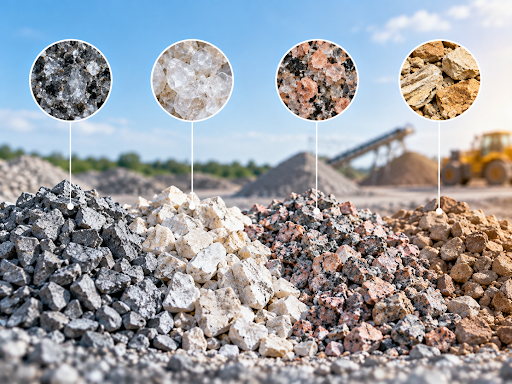
Aggregate mineralogy sets how hard a stone is, how it reacts with its surroundings, and how well it bonds with cement or asphalt, so it quietly decides how long a slab, road, or base will last. Two gravels can pass the same sieve and still age very differently once they're in the ground. Western Materials understands the importance of selecting the right aggregates for long-lasting construction.
This post explains how that works. We look at mineral hardness and durability, what petrographic characteristics reveal about a stone, why chemical reactivity can cause trouble years after a pour, and how aggregate-binder compatibility affects concrete and asphalt. We finish with practical advice for choosing material.
How Does Mineral Hardness Affect Durability?
Start with the minerals themselves. Hardness is ranked on the Mohs scale, where quartz sits at 7 and softer minerals like calcite and gypsum land around 2 to 3. A stone rich in quartz and durable feldspar tends to hold up under traffic. One with plenty of soft mineral content wears, crushes, or polishes much sooner, making aggregate hardness in construction applications an important factor when selecting stone for roads, concrete and other projects.
That's why igneous rocks such as granite and basalt are generally tougher, while sedimentary rocks like limestone and sandstone vary more from one source to the next. The effects show up in ordinary ways. Soft rock can polish smooth and turn slick in wet weather, and weak particles can break away from the binder, leaving depressions that grow into potholes. The Los Angeles abrasion test is a common way to measure how a stone handles that punishment.
Not sure which stone suits your job?
Contact Us
What Do Petrographic Characteristics Tell You?
Petrography is the study of rock under a microscope. The petrographic characteristics it reveals include which minerals are present, how they're arranged, how coarse the grains are, and whether the rock has pores, cracks, or weathered zones. A sieve analysis tells you about particle size distribution, while a petrographic examination reveals the minerals and condition of the stone. Particle shape matters too, and the flakiness index of construction aggregates helps assess the proportion of flat or elongated particles in a sample.
Texture matters as much as the mineral names. Porous stone soaks up water, and in cold climates that water can freeze and crack the stone from the inside. Decomposed granite is a handy reminder that rock changes over time, since it's simply weathered granite broken down into granular fragments.
Can Chemical Reactivity Cause Problems Later?
Some aggregates contain minerals that react with the alkalis in cement over time. That alkali-silica reaction can cause expansion and cracking in concrete, which is why reactivity testing sits among the standard tests used for construction aggregate. Soundness testing, which shows how a stone resists weathering, belongs there too.
That's a reason to check the test data before ordering, as aggregate properties need to suit the concrete mix. Aggregate absorption and concrete mix design are closely related because the amount of water absorbed by the stone can affect the mix's effective water content.
Want to see test data before you decide?
Talk To Us
Why Does Aggregate–Binder Compatibility Matter?
Aggregates make up roughly 60 to 80 percent of concrete's volume, so the bond between stone and binder decides whether a surface stays intact. Aggregate–binder compatibility describes how well that bond forms and how long it survives traffic and moisture, whether the binder is cement paste or asphalt.
Surface texture plays a big part. Rough, angular particles give a binder more to grip, while smooth, polished or dusty particles bond less well. When aggregate fails to bond properly with its binder, the surface can develop raveling, spalling or potholes. In concrete work, poor sand selection and honeycombing are also concerns, as unsuitable materials and inadequate placement can leave voids in the finished structure.
Final Thoughts
Mineralogy plays an unseen role in any paved surface, influencing its hardness, reactivity and bonding ability over time. In areas exposed to repeated freezing and thawing, freeze-thaw effects on aggregate performance are another consideration when choosing durable construction materials.
For your needs of sand and gravel in Sacramento, we at Western Materials provide material for residential, commercial, and civic construction projects, deliver it to locations like Folsom, Rancho Cordova, Elk Grove, and Auburn, and also arrange pick-up from our Sacramento location. Contact us to discuss your project needs and find the right materials for your next construction project.
Frequently Asked Questions
1. What is aggregate mineralogy?
The term aggregate mineralogy refers to the mineral content of an individual rock. Aggregate mineralogy influences the hardness, abrasiveness, chemical activity, and capability of the rock to bond to either the cement or asphalt. The same size of two rocks can exhibit different behavior due to the variation of their mineral compositions.
2. How are petrographic characteristics examined?
A petrographer uses a thin section of the rock through a microscope to determine the presence of minerals, grain structure, porosity, and evidence of weathering and reactive materials. Petrographic investigation complements sieve analysis in that it is concerned with the size of particles only. Consult your engineer or supplier regarding this.
3. Does mineral hardness always mean better durability?
No, mineral hardness does not always mean better durability. Hard minerals like quartz display high wear resistance, while durability can depend on various aspects such as porosity, form, soundness, and purity. Even a highly hard mineral grain that is broken or contaminated might fail earlier than expected because of pressure.
4. What is alkali-silica reactivity?
Alkali-silica reactivity occurs due to the reaction between certain aggregates containing silica and alkalis present in cement, resulting in expansion and cracking of concrete. This occurs very slowly; hence, it may be revealed many years after pouring the concrete. Pre-testing enables you to pick an aggregate or concrete mixture without experiencing this problem.
5. Can Western Materials provide material test information?
Yes. For most of our sand and gravel, we have material test lab reports available when your job requires them, and small samples can be arranged on certain materials for large orders over 100 cubic yards. Call us or request a quote and describe how it will be used.
.avif)
Materials management and founders
have produced and supplied high quality
sand and gravel to contractors &
aggregate users across California.
.svg)
.svg)


