

Why Is Aggregate Absorption Important in Concrete Mix Proportioning?
Published on:
November 27, 2026
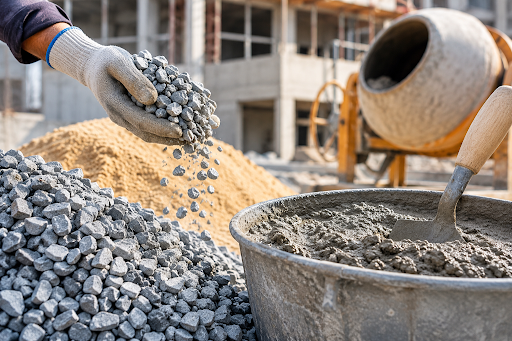
Aggregate absorption matters in concrete mix proportioning because the water an aggregate soaks up never reaches the cement, so it changes the effective water-cement ratio you actually end up with. Ignore it, and a mix that looks right on paper can turn out too stiff to place or too wet to be strong. This is closely connected to SSD condition in aggregate testing, which helps determine how much water the material can hold without affecting the mix.
In this blog, we'll cover what aggregate water absorption is, how it feeds into concrete mix proportioning, and how it ties back to the cement hydration process. Western Materials has supplied sand and gravel to California contractors for over 40 years, and we see the same moisture mistakes show up on jobs of every size.
What Aggregate Water Absorption Actually Means
Aggregate looks solid, but it isn't. Sand grains and stones have tiny pores inside them, and those pores can fill with water. It's the reason a pile can feel dry and still hold plenty of water. Aggregate water absorption is the amount of water an aggregate holds in those pores when it's fully soaked but has a dry surface, a state called saturated surface dry, or SSD. It's expressed as a percentage of the aggregate's dry weight.
Different materials absorb different amounts. Dense crushed stone may take on a small fraction of a percent, while some sands and porous rock take up a good deal more. Material properties also matter when checking aggregate durability through the Micro-Deval test, particularly when selecting aggregates for demanding construction applications.
That's why you can't assume one number works for every source. Testing under ASTM C127 for coarse aggregate and C128 for fine gives you the real figure. If you want a closer look at SSD, our post on SSD condition in aggregate testing covers it.
How Aggregate Absorption Changes Concrete Mix Proportioning
Mix designs usually assume aggregate is in SSD condition. On the job, it rarely is. Stockpiles are either drier than SSD or wetter.
Here's a simple example. Say a batch uses 1,800 pounds of sand that absorbs 1.5 percent of its weight. That's about 27 pounds of water, or roughly 3 gallons. If the sand goes bone dry and you don't adjust, the sand pulls those 3 gallons out of your mix water, and the paste ends up stiffer than you planned.
Now flip it. If that same sand carries 4 percent moisture, only 1.5 percent of that is absorbed. The other 2.5 percent sits on the surface as free water, around 45 pounds or 5 gallons. Add your full batch water on top, and you've quietly raised the water content.
That's why concrete mix proportioning always includes a moisture correction. You measure what's in the stockpile, then add or remove water to compensate.
Need washed concrete sand for your next pour? Tell us the quantity, and we'll price it out.
Get a Quote
Why the Effective Water-Cement Ratio Is the Number That Counts
The effective water-cement ratio is the water that's actually available to the cement, after the aggregate has taken its share. It's different from the total water you add. A batch can have the same total water on two different days and behave very differently, because the aggregate absorbed more on one of them.
This number drives strength and durability. A higher effective ratio leaves more water in the paste than the cement can use. Poor control over the mix can also contribute to problems such as concrete cracking, particularly when water content and other mix proportions are not properly managed. When that extra water leaves, it leaves behind small pores, and those pores make the concrete weaker and easier for moisture and chemicals to get into. A lower ratio gives denser paste, but go too low, and the mix becomes hard to place and finish.
So the goal isn't a low number for its own sake. It's a number you can predict and repeat from batch to batch, and tracking absorption is how you keep it steady.
Aggregate Absorption and the Cement Hydration Process
The cement hydration process is the chemical reaction between cement and water that makes concrete harden and gain strength. Cement grains react with water to form a binding gel that fills the spaces between aggregate particles. No water, no reaction.
Cement needs less water to hydrate than most mixes contain. The rest is there so the concrete can be mixed, pumped, and placed. That's where absorption causes problems. If dry aggregate pulls water out of the paste early, the mix stiffens fast, finishing gets harder, and the paste may not have enough water around the cement grains to react evenly. Poor material selection and mix consistency can also contribute to honeycombing in concrete, leaving unwanted voids in the finished structure.
If wet aggregate adds water, the paste gets thinner than planned, and you end up with more voids than the design intended.
Either way, the hydration process works best when the water balance is close to what the mix design called for.
How to Account for Aggregate Absorption on the Job
Start by getting the absorption value for each aggregate from a lab test, and keep it on file. Then check the moisture content of your stockpiles regularly, especially in the morning and after rain or watering. Many plants use a quick oven or burner dry-down, and some use moisture probes in the bins.
Adjust the batch water by the difference between the measured moisture and the absorption. Cover stockpiles where you can, since a consistent pile is easier to correct. And use clean material. Silt and clay clinging to sand can raise water demand and throw off your numbers, which is one reason many mixes call for washed sand. The benefits of cleaner sand are also important in masonry work, where washed plaster sand can improve stucco bonding and durability.
Keep records too. A simple daily log of moisture readings and adjustments makes it easy to trace a problem back if a batch behaves oddly, and it shows the next crew what's normal for that yard.
Conclusion
Aggregate absorption is a small percentage that makes a big difference. Once you account for it, the effective water-cement ratio stays on target, the cement hydration process has the water it needs, and your mix behaves the way the design says it should. If you're sourcing washed concrete sand for your next pour, Western Materials can help you pick the right grade and arrange delivery across California. Call us now.
FAQs
What is aggregate water absorption?
Aggregate water absorption is the amount of water an aggregate holds inside its pores when it's saturated but has a dry surface. It's measured as a percentage of the aggregate's dry weight. Lab tests under ASTM C127 and C128 give the value, which designers use to adjust the batch water.
What is the difference between absorption and moisture content?
Absorption is the most water an aggregate can hold inside its pores. Moisture content is the water it actually contains right now, including any on the surface. If moisture is above absorption, the extra is free water that adds to the mix. If it's below, the aggregate will absorb water.
What is the effective water-cement ratio?
It's the ratio of water available to react with cement compared to the weight of cement, after the aggregate has absorbed its share. Free surface water counts toward it, while absorbed water doesn't. It's the number that controls strength and durability, which is why mix designers track it so carefully.
How does absorption affect the cement hydration process?
Cement needs water to react, and absorption changes how much it gets. Dry aggregate can pull water from the paste and leave it too stiff, while wet aggregate can dilute it—both of these upset the balance. Adjusting for absorption keeps enough water around the cement grains for even hydration.
How often should aggregate moisture be checked?
Check moisture at the start of each production day, and again after rain, watering, or when you switch to a different part of the stockpile. Big swings can happen fast. Regular checks let you adjust batch water before the mix drifts off target, which keeps your effective water-cement ratio consistent.

Materials management and founders
have produced and supplied high quality
sand and gravel to contractors &
aggregate users across California.


