

What Is the Elongation Index and How Is It Measured?
Published on:
October 27, 2026
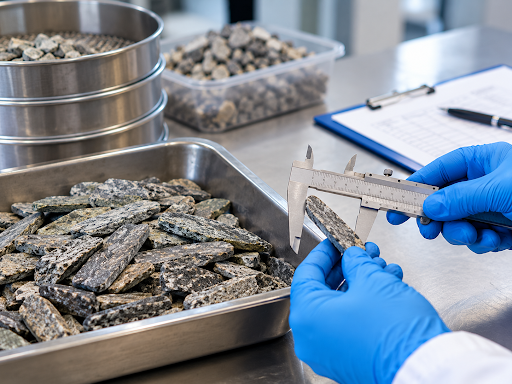
The elongation index is the percentage of aggregate particles, by weight, that are noticeably longer than they are wide. You measure it by sieving a sample and passing each particle through an elongation gauge. The elongation index test is a simple but important check on aggregate quality. Along with factors such as aggregate density, gradation, and compaction, it helps determine how aggregates perform in construction applications.
At Western Materials, we use it to make sure the rock we supply behaves well in concrete, asphalt, and base layers. This blog covers what the test involves, how to read the results, and why particle shape affects real-world performance.
Why Particle Shape Matters in Aggregates
Two batches of crushed stone can have the same size and the same strength, yet perform very differently. The difference is often in shape. Rounded or cubical pieces pack tightly and lock together, creating the aggregate interlock needed for a stable base, while long, needle-like pieces can leave gaps and weaken that structure. They leave bigger gaps, they break more easily under load, and they make concrete harder to place and finish.
That’s why engineers pay attention to flakiness index and elongation characteristics when they approve a material. A mix with too many slivers needs more cement or binder to fill the extra voids, which pushes up cost without adding strength.
How the Elongation Index Test Is Done
The procedure is simple, and most labs follow a standard such as BS 812. Here’s the usual flow:
- Dry the sample and sieve it into separate size fractions.
- Weigh each fraction that is large enough to test.
- Pass the particles through an elongation gauge, which is a metal board with slots of set lengths for each size fraction.
- Set aside the particles that can’t fit through the slot, since those are the elongated ones.
- Weigh the rejected pieces and divide by the total weight tested.
Multiply by 100, and you have the elongation index. The key idea is the length-to-thickness ratio. A particle whose longest dimension is much greater than its average size gets flagged. The lower the final number, the more cubical and dependable the aggregate.
Reading Results and Particle Shape Classification
A single percentage tells you a lot, but it makes more sense when you sort the material into groups. Particle shape classification generally puts aggregate into a few buckets: cubical, flaky, elongated, or a mix of flaky and elongated. Most specifications set a ceiling, and many road and concrete jobs ask for a combined flakiness and elongation figure that stays under roughly 30 to 35 percent. Always check your own project spec, because limits vary by application and by agency.
If your result lands above the limit, it doesn’t automatically mean the stone is useless. It may point to a problem at the crusher, such as worn liners or the wrong feed setting, that can be fixed.
Elongation Index vs Flakiness Index
People mix these two up all the time, so here’s the simple version. FFlakiness is about thickness: it flags thin, flat pieces. Elongation is about length: it flags long, narrow pieces. Both tests complement sieve analysis for determining aggregate gradation when assessing a sample. A flake can also be elongated, and a needle can also be flat, which is why labs often run both tests on the same sample.
Think of it this way: flakiness tells you whether pieces are plates, and the elongation index tells you whether they’re sticks. Aggregate that has plenty of both will struggle to compact properly.
Need an aggregate you can trust
Get Quote Now!
Where Elongated Particles Cause Trouble
Elongated pieces are more likely to snap during compaction, which creates fines and changes your gradation after it’s already been placed. In concrete, they can trap water underneath and weaken the paste bond around them.
Under saturated flow conditions, such as in a drain rock layer or a base that stays wet, particle shape influences how water moves through the voids, making void structure in aggregate drainage an important part of material selection. Poorly shaped stone can shift, settle, or clog sooner than well-shaped stone.
Keeping Elongated Particles in Check
Good shape starts at the source. Choosing a hard, consistent deposit, using well-maintained crushers, and screening all help properly. Testing should be routine instead of occasional, since shape can drift as equipment wears or the quarry face changes. If you’re buying material for a job, ask for recent results, not a result from last year.
Planning a project and not sure which aggregate fits?
Talk to our team
Conclusion
The elongation index test gives you a quick, reliable read on whether aggregate will pack well, hold up under load, and perform over time. It’s cheap insurance against problems that are expensive to fix later.
If you’re looking for sand and gravel in San Gabriel Valley, Western Materials supplies tested, quality-controlled aggregate for residential, commercial, and infrastructure projects. Reach out to us, and we’ll help you pick the right material for the job.
Frequently Asked Questions
1. What is a good elongation index value?
It depends on the specifications, but most jobs will specify a value that is less than 25% to 30%. The combined values for flakiness and elongation may be slightly higher. Please make sure to check the limit for the job because there may be different limits for each type of job.
2. What equipment is needed for the elongation index test?
Test sieves, sieve shaker, balance, oven for drying, and elongation gauge will be required. The elongation gauge will serve as the primary equipment, with slots of various sizes depending on the fraction being tested. In most commercial laboratories, all of these pieces of equipment will be available.
3. Is the elongation index the same as the flakiness index?
No. The elongation index measures long, narrow particles, while the flakiness index measures thin, flat ones. They describe different shape problems, though the same particle can fail both. That’s why labs commonly run both tests together to get a complete picture of the aggregate.
4. Does particle shape affect concrete strength?
Yes. Long and flat aggregates lead to more voids and less workability; hence, more water and cement may be required in the mix. Also, these aggregates may easily fail under loads. Cubic aggregate offers more strength to concrete.
5. How often should aggregate be tested for elongation?
Test the source whenever it changes and on a routine basis during production due to the possibility that wear of the crushers will change the particle shapes. If you are working on a larger project, you will find that most specifications call for testing at intervals or based on stockpiles.

Materials management and founders
have produced and supplied high quality
sand and gravel to contractors &
aggregate users across California.


