.png)

Why Rip Rap is Commonly Used Around Bridges and Infrastructure
Published on:
June 30, 2026
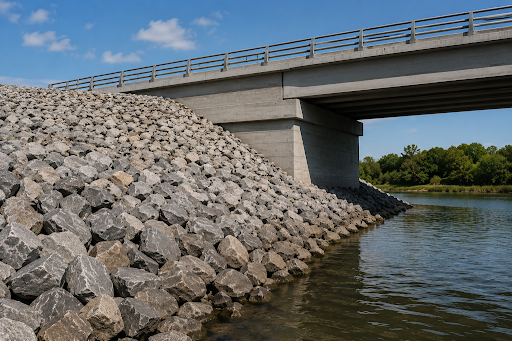
Most people driving across a bridge never really pause to think about what’s going on underneath it. They look at concrete, steel, guardrails, maybe water down there, then they just keep moving. But under many bridges, especially around rivers and drainage channels, there’s this ongoing tug of war with moving water and soil erosion.
That’s where rip rap rocks come in.
You’ve probably already seen it, even if you didn’t know the name. It’s those large broken stones set along riverbanks, around bridge supports, near culverts, or running beside highways. On the surface, it seems straightforward, but it does a lot more than it first appears. It helps shield infrastructure from water damage in a pretty direct way.
At Western Materials, we supply rip rap for projects where erosion is not just a cosmetic problem. Many rip rap around bridges uses involve protecting roads, bridge foundations, slopes, and drainage systems from long-term structural damage caused by moving water and soil erosion.
Why Water Creates Problems Around Bridges
Water never stays still for long. Even smaller rivers and drainage channels slowly wear away soil over time. During storms or heavy runoff, the pressure increases fast.
As water moves around bridge supports, it creates turbulence and strong hydraulic forces that pull soil away from foundations. Engineers call this riverbed scour. If enough soil disappears, the structure above can eventually become unstable.
This is one reason bridge scour protection is taken so seriously in construction and infrastructure work.
Water also creates problems along slopes and embankments near roads. Once erosion starts, it usually spreads. A small washed-out area can slowly become a major repair project after repeated storms.
Rip rap helps slow that process down.
How Rip Rap Actually Works
Rip rap works by breaking up the energy of moving water. Instead of water hitting exposed soil directly, the rock absorbs and redirects the force.
The rough surface created by large angular stone helps with water flow velocity reduction, which lowers the chance of erosion underneath. It also helps reduce hydraulic shear stress along the surface of banks and slopes.
The shape of the stone matters too. Angular rock locks together better than smooth river rock. That makes the material harder to shift during heavy rain or flooding.
A properly installed layer of erosion control rock can hold up for years with very little maintenance.
Common Rip Rap Around Bridges Uses
There are several rip rap around bridges uses that show up repeatedly in infrastructure work.
One of the most common is around bridge abutments and support areas where moving water creates constant pressure. Rip rap protects the soil around those sections and helps reduce scour problems during storms.
It is also used around:
- Drainage channels
- Culvert outlets
- Highway embankments
- Shorelines
- Retaining walls
- Flood control systems
In river areas, rip rap is often part of larger riverbank stabilization methods designed to prevent streambank erosion and protect nearby infrastructure.
Without some kind of protection system, flowing water can slowly reshape an entire bank over time.
Why Rip Rap Is Still Used So Often
Construction materials change constantly, but rip rap has stayed common for one reason. It works.
There are modern erosion systems available today using concrete mats, synthetic materials, and reinforced structures. Some are effective in the right situation. But many contractors and engineers still prefer rock because it handles changing conditions well and does not require complicated installation.
Rip rap can also adapt naturally as water levels rise and fall.
That flexibility matters near rivers and flood-prone areas where conditions are unpredictable. A rigid system may crack or fail under pressure. Properly placed slope protection rock tends to absorb movement better.
Another benefit is drainage.
Water can move through the gaps between stones instead of building pressure behind walls or slopes. That is important in retaining systems where trapped water often causes failure.
This is why retaining wall drainage rock is commonly included behind wall structures and reinforced slopes.
Rip Rap Helps More Than Just Bridges
People usually connect rip rap with highways and bridge systems, but it is used in many other areas, too.
In shoreline projects, shoreline protection stone helps reduce erosion caused by wave action and changing water levels. Around rivers and streams, riverbank armoring protects soil from washing away during periods of heavy flow.
Rip rap is also important for sediment transport control. When banks erode heavily, loose soil moves downstream and creates problems in drainage systems and waterways. Stabilizing the area helps reduce that movement.
In some projects, the goal is not to stop water completely. It controls how the water behaves so the surrounding infrastructure survives long-term.
That is a big difference.
Choosing the Right Rock Matters
Not all rip rap is the same size. The material used for a small drainage ditch is completely different from what is needed around a bridge carrying heavy traffic over fast-moving water.
Engineers usually look at:
- Water speed
- Flow direction
- Slope angle
- Soil condition
- Flood risk
- Expected storm activity
If the rock is too small, strong currents can move it out of place. Once gaps start forming, erosion underneath can spread quickly.
At Western Materials, we work with contractors and project managers who need dependable material for infrastructure jobs, not decorative landscaping rock. The right material makes a difference when projects are dealing with flood water impact mitigation and channel flow stabilization in high-pressure environments.
A lot of people searching for Rip Rap near me are trying to solve an active erosion problem quickly. But using the wrong size or poor-quality stone usually creates more work later.
Why Infrastructure Projects Continue Using Rip Rap
Infrastructure repair costs keep rising, especially around roads and bridges exposed to heavy weather conditions. Once erosion damages foundations or embankments, repairs become expensive fast.
That is why preventative protection matters.
Rip rap stays one of the most practical solutions, because it is durable, relatively simple to install, and it performs well even when conditions shift. It can help manage hydraulic forces without needing overly complex systems in the background, or at least not the kind of people usually expect.
For a lot of projects, the simple and reliable option still wins, more often than not.
At Western Materials, we keep supplying rip rap and other construction materials for contractors tackling bridge work, shoreline reinforcement, drainage jobs, and erosion control systems across tough environments. Solid material really matters when the goal is long-term protection rather than a quick, temporary patch.
Conclusion
Rip rap might look like some kind of plain layer of stone, but really, it plays a meaningful role in safeguarding bridges, coastlines, slopes, and important infrastructure from water damage. It helps, from easing streambank erosion to backing bridge scour protection, it kind of stabilizes spots that face steady water pressure and those shifting flow conditions.
As storms get tougher and infrastructure keeps aging, erosion control gets even more essential. With properly installed rip rap, contractors and engineers have a steady method to protect roads, bridges, and waterways before minor erosion becomes a major structural concern.
FAQs
1. How does Western Materials help with rip rap supply?
Western Materials supplies construction-grade rock for erosion control. Also, bridge protection and stabilization projects, you know the ones where water kinda keeps showing up, again and again. We help contractors source the right materials for rip rap around bridges, shoreline reinforcement, retaining wall drainage, and infrastructure jobs where durability matters under long-term water exposure, even when conditions change.
2. Why is rip rap commonly used around bridges?
Rip rap helps protect bridge foundations and the surrounding soil from erosion caused by moving water. It absorbs hydraulic forces, and it also reduces riverbed scour. Then it helps stabilize embankments during storms, flooding, and those changing water conditions around infrastructure systems.
3. What type of rock works best for erosion control?
Angular stone is usually preferred. That’s because it locks together better than smooth rock, and that matters. It builds a more stable surface that resists movement during strong currents, heavy rainfall, and flood events while still improving long-term erosion protection.
4. Can rip rap help stabilize riverbanks?
Yes, absolutely. Rip rap is widely used in riverbank stabilization methods because it helps reduce streambank erosion. It also protects soil from washing away. In addition, it supports slope stability, and it helps manage sediment movement in waterways when flows shift.
5. Where else is rip rap commonly installed?
Besides bridges, rip rap is often used around drainage channels, shorelines, culverts, retaining walls, flood control systems, and highway embankments. It’s commonly placed anywhere moving water creates erosion risks or slope stability concerns, so basically, where the ground needs extra armor.
.avif)
Materials management and founders
have produced and supplied high quality
sand and gravel to contractors &
aggregate users across California.
.svg)
.svg)


