.png)

Why Is Mason Sand Unsuitable for Volleyball Courts?
Published on:
August 31, 2026
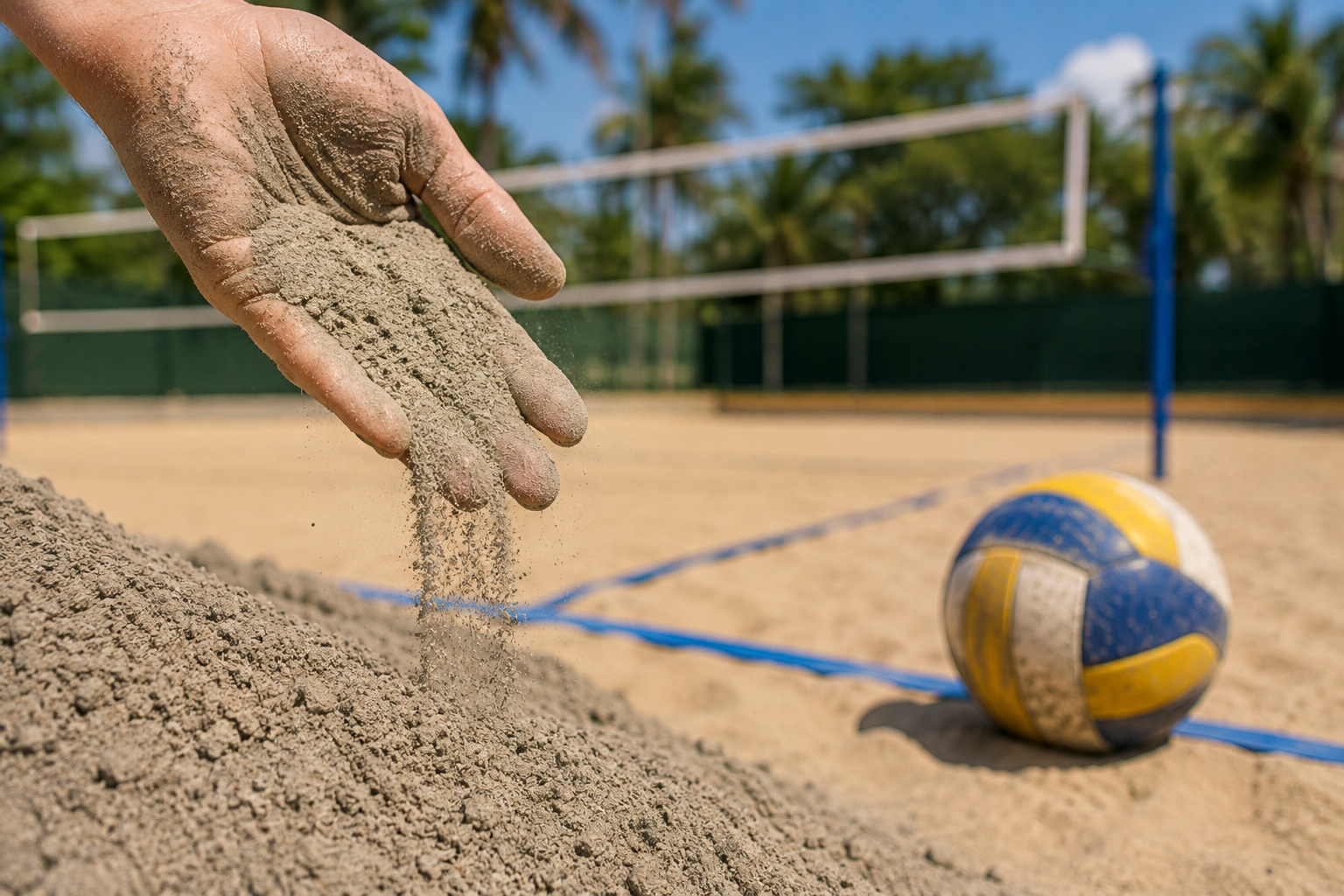
When building a high-performance outdoor or indoor volleyball court, choosing the right aggregate is the single most critical decision you will make. While it might be tempting to use masonry sand because it is inexpensive and widely available at local supply yards, doing so often ruins the playing experience and creates safety hazards. Mason Sand is engineered specifically for mixing mortar, laying brick, and setting paving stones, not for sports impact absorption or barefoot athletic activity.
At Western Materials, we’ve seen countless court projects falter simply because the wrong sand was chosen at the start. In this all-encompassing guide, we’re going to look at why mason sand can go sideways on the court, then unpack the real physical science behind sports aggregates. After that, we’ll cover which exact specifications you actually need, so you end up with a safe, professional playing surface.
The Structural Difference: Mason Sand vs. Court Sand
To understand why masonry aggregates fail in sports applications, it helps to examine what each material is designed to do.
Mason sand is manufactured by crushing rock and screening it to a fine consistency. It contains a high percentage of fine particles, rock dust, and silts so that it blends smoothly with cement and water to bind bricks tightly together. That exact binding property is problematic for athletic courts and highlights the risks of using improper sand on a volleyball court. When exposed to outdoor weather and player foot traffic, mason sand packs down into a hard, cement-like crust.
Dedicated volleyball court sand, by contrast, is washed and graded specifically to remain loose, airy, and free-draining under constant compaction pressure.
Particle Size Distribution and Sieve Grading
A primary reason masonry aggregate fails in recreational installations comes down to particle size distribution.
Aggregate grading is usually checked by using lab test sieves. A good sports sand needs its own gradation curve, which is why the ideal particle size for volleyball sand is an important consideration. It typically sits between 0.25 mm and 1.0 mm; that 0.25-1.0 band is the coarse to medium sand zone. When the particles get really small, under about 0.15 mm, they tend to get carried off by the wind, and during play they can become airborne dust while people rake and spike the surface.
Also, they can’t get up drainage perforations; not ideal. On the other side, if the grains are too chunky, like above 2.0 mm, then it ends up feeling like you’re walking over little pebbles, not sand.
Mason sand has a heavy amount of very small grains, plus unwashed mineral dust here and there. Those tiny particles sneak into the spaces between bigger grains, so the whole thing ends up holding together on its own. On a volleyball court, this can form a tight, not really yielding base, and it quietly ramps up the odds of rolled ankles and also those jarring impacts on your joints.
Angular vs. Rounded Grains: Player Safety and Comfort
The microscopic shape of each grain dictates how the court feels beneath a player's feet. The debate between angular vs. rounded grains is the defining factor in sports surface safety.
- Angular Grains (Masonry Sand): Made via mechanical stone crushing, these grains end up with sharp fractured edges and jagged facets. So when players slide, dive, or land, those uneven corners snag against each other, essentially making the surface lock into a packed layer. And more importantly, the sharp angular bits behave like sandpaper on bare skin, leading to bad abrasions, mat burns, and painful cuts.
- Sub-Angular to Rounded Grains (Recreational Beach Sand): Naturally weathered by river flow or marine tides, rounded grains roll smoothly over each other. They provide natural fluid resistance that cushions high jumps and diving, which contributes to volleyball sand actually feeling good underfoot.
Choose the Right Sand for Safer Play
Request Court Sand Quote
Drainage Performance and Weather Resilience
Outdoor courts are continuously exposed to seasonal rain and automated landscape watering. A properly built recreational court relies on rapid vertical drainage to prevent waterlogging.
Mason sand has poor drainage performance. Because its fine particles fill every available void space, water cannot percolate downward through the court base. Instead, rainwater pools on the surface, turns the court into heavy mud, and washes away fine sediments toward the edges, contributing to volleyball court sand loss over time. Once the court finally dries in the sun, the remaining silts bake into an unplayable, hardened crust.
Specialized sports aggregate lets water filter freely into the underlying gravel drainage trench, allowing games to resume within minutes after a heavy rain shower.
ASTM Volleyball Sand Standards and Specifications
Professional organizations and governing bodies—including USA Volleyball, the NCAA, and the FIVB—rely on rigorous structural criteria aligned with ASTM volleyball sand standards (such as ASTM F1815 and ASTM C136) to verify aggregate safety.
ASTM Gradation Benchmark for Competitive Courts:
├── Coarse Sand (1.0 mm – 2.0 mm): ≤ 5% to 12%
├── Medium Sand (0.25 mm – 0.5 mm): ≥ 60% to 75% (Target Zone)
├── Fine Sand (0.15 mm – 0.25 mm): ≤ 15%
└── Silt & Clay Fines (< 0.075 mm): < 1% (Cleanliness Target)
Meeting these strict thresholds requires dedicated washing and hydro-sizing systems that strip out clay, organic matter, and ultra-fine dust—refinements that standard mason sand does not undergo.
Upgrade Your Court with ASTM‑Approved Sand
Talk to Aggregate Experts
Conclusion
Cutting corners with the wrong aggregate can turn an exciting court build into an expensive maintenance headache. While masonry material works well for laying block and setting flagstones, its angular grain structure, high dust content, and tendency to pack hard make it basically entirely unsuitable for competitive athletics.
Putting money into laboratory-tested, washed, and properly graded volleyball sand is an important part of building the perfect sand volleyball space. It helps your athletes avoid painful abrasions, stops standing surface water, and keeps your court loose and responsive for years of competitive play.
Western Materials is a trusted supplier across California, providing premium sports aggregates, construction gravel, landscaping stone, and specialty field materials. Contact us today for a quote.
Frequently Asked Questions
What is the primary difference between mason sand and volleyball sand?
Mason sand is basically a finely crushed aggregate, with sharp edges and a fair amount of dust; it’s made for cement mortar. The specialized sand used for volleyball is different— it’s washed so there’s less residue, and the grains are rounded, typically in the 0.25 mm to 1.0 mm range. This drains water fast, stays put without too much compaction, and it also helps cushion players from joint impacts as well as those irritating skin scrapes.
Can mason sand be mixed with other materials to build a court?
No, it’s not really a good idea to mix mason sand with other aggregates. In the masonry mix, the smaller stuff, meaning fine particles and dust, tends to slip down between the bigger sand grains and settle into the pore spaces. After that, the whole surface ends up packing down hard, which then ruins the drainage, and that can raise player injury risks.
Why does mason sand get so hard after it rains?
Mason sand has high amounts of silt, clay, and fine rock dust that sits around in tiny layers. When rain hits the court, those microparticles quickly soak up moisture and turn into this thick, dragging slurry. Then, as the water evaporates under direct sunlight, the fine grains start to bind tightly together, and eventually they form a hard, unyielding crust on your court.
Is beach sand always suitable for sports courts?
Not every beach sand is really suitable for athletic courts. Unprocessed shoreline sand can conceal busted seashells, tiny coral fragments, natural salt residue, and all jagged bits that end up scraping at exposed skin. For high-performance play, the sand really has to be cleaned up thoroughly, run through screens, and sorted in a mechanical way so the particle size remains even, and so the players stay safe for a long time.
How deep should the sand layer be on a standard volleyball court?
For a normal outdoor court, you really want a steady overall aggregate buildup around 12 to 18 inches, put over a well-compacted gravel sub-base, and then add a geotextile drainage sheet. The point of this thickness is that it gives you enough softness for things like diving and jumping, yet it also reduces the chance of players getting too much contact, like bumping into or hitting hard on the drainage stone beneath once the matches get more intense.
.avif)
Materials management and founders
have produced and supplied high quality
sand and gravel to contractors &
aggregate users across California.
.svg)
.svg)


