.png)

Why Does Aggregate Hardness Matter in Construction Applications?
Published on:
September 24, 2026
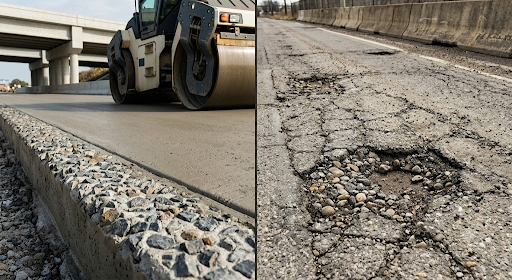
When contractors pour a foundation, lay down an asphalt highway, or build a retaining wall, their focus naturally gravitates toward mix ratios, water content, and curing schedules. Yet the real backbone of any mix is the stone and sand locked inside it. Coarse and fine aggregates make up between 60% and 80% of concrete's volume and an even higher percentage of road base layers.
If those individual rock fragments cannot withstand abrasive friction, point-load compression, or regional climate shifts, the surrounding cement paste cannot compensate. Understanding aggregate hardness is therefore fundamental to avoiding premature structural cracking, surface rutting, and costly pavement failures.
In this guide, we examine why mineral hardness dictates field performance, how the construction industry measures rock toughness through laboratory testing, and how selecting the right aggregates protects your investment over decades. At Western Materials, we supply contractors, developers, and homeowners across California with thoroughly graded aggregates, crushed rock, and specialty sands engineered to meet rigorous Caltrans, Greenbook, and ASTM specifications.
How Aggregate Hardness Dictates Load-Bearing Capacity
In any structural composite, cement acts purely as the binding glue; the aggregates bear the physical weight. When heavy equipment, commercial freight, or multistory building loads exert pressure on a slab, force transfers across the contact points between adjacent rock fragments. This is where aggregate interlock becomes important for load distribution and stability.
If the mineral composition of the aggregate contains soft and friable minerals like shale, chalk, or weathered sandstones, then there will be breaking under pressure when the materials get crushed, and that will cause microscopic voids inside the hardened concrete. With the creation of these voids in the interiors, the compressive strength goes down drastically, and this causes cracks in the form of spiderwebs, spalling at the surface, and sinking of the sub-base.
Abrasion Resistance and Everyday Surface Wear
Not all aggregate failures happen through sudden structural collapse. Surface deterioration is a perpetual problem on pavements, taxiways at airports, bridge decks, and floors of industrial warehouses because of constant friction. Vehicle tires, steel wheels, forklift traffic, and abrasives keep abrading the topmost concrete layer.
When aggregates lack adequate abrasion resistance, traffic polishes or breaks down the exposed stone. This wear causes two distinct problems:
- Micro-De-bonding and Potholes: Weak rocks break apart beneath tyres, dislodging from the binder and leaving small depressions that rapidly grow into full potholes.
- Loss of Skid Resistance: Hard, angular aggregates stay rough as they gradually wear down, providing crucial traction in wet weather. Softer rocks polish smooth, creating dangerously slick driving conditions on wet roads.
Using hard crushed stone with high mechanical wear resistance helps road surfaces retain their texture and grip, while particle interlock improves road base performance by helping aggregate particles resist movement under traffic.
Sourcing Proven Materials for Your Job Site?
Request a Quote
Essential Testing: Mohs Hardness and the Los Angeles Abrasion Test
Engineers do not employ any guesswork in evaluating the quality of construction rock since they test for the minerals and the mechanical properties through the standardised testing process.
The Mohs Hardness Scale
In geology, mineral hardness is measured using the Mohs hardness scale, which ranks minerals from 1 (softest) to 10 (hardest). For high‑performance structural concrete and asphalt, aggregates rich in quartz (Mohs 7) and durable feldspar minerals deliver superior strength and resilience. In contrast, softer minerals such as calcite or gypsum (Mohs 2–3) tend to underperform, making them less suitable for demanding construction applications.
The Los Angeles Abrasion Test
In lab-quality assurance testing, the standard Los Angeles abrasion test, also known as the L.A. Abrasion Test, is described by ASTM C131 and ASTM C535. The test involves putting an oven-dried aggregate sample in a steel drum along with a certain number of steel balls. The steel drum will be rotated at about 30 to 33 rpm, causing the steel balls to hit the aggregates.
After 500 rotations, the sample is sieved through a fine mesh (No. 12 sieve) to determine what percentage of the material broke down into fine dust.
- A low loss percentage indicates an aggregate that resists fracturing and wear.
- State transport authorities generally cap allowable L.A. Abrasion loss at 35% to 45% for surface asphalt courses and concrete wearing slabs to ensure long-term durability.
The Aggregate Hardness Test (Impact and Crushing Values)
Alongside rotational tumbling, labs perform the Aggregate Crushing Value (ACV) and Aggregate Impact Value (AIV) tests, while the flakiness index in construction aggregates helps assess particle shape. These subject stones to direct mechanical compression and sudden shock loads, measuring an aggregate's ability to resist catastrophic splintering when machinery drops heavy loads onto a floor or road deck.
Aggregate Durability Across Harsh Weather Cycles
Hardness is essential for aggregate durability in general because of the fact that in some instances, construction occurs in areas where there are extremes in the weather conditions.
Aggregates that are soft and have high porosity absorb water easily, which is one reason aggregate absorption affects concrete mix design. When winter occurs and there is a drop in temperatures to below freezing, the water inside the stone expands by approximately 9%. Repeated freeze-thaw cycles can affect aggregate performance, especially when water gets into softer or more porous stone.” This expansion will crack the stone due to the pressure exerted, which results in D-cracking.
When there is hot sun and cold nights, the stone is subjected to thermal stress. The harder and less porous stone will withstand the pressure without cracking.
Need Guidance on Soil, Sand, or Base Specifications?
Contact Our Aggregate Specialists Today
Conclusion
Cuts in the material used and the stone chosen always end up causing unnecessary structural repairs, expensive claims, and delays. It is important to choose the right materials with the correct physical hardness and abrasion resistance so that they can withstand years of traffic and use.
With 40 years’ experience in the region, we at Western Materials offer top-quality gravel, crushed rock, road base material, and specialized sand to constructors, municipal corporations, and private property owners. If you are looking for reliable sand suppliers near me in California to maintain compliance and efficiency of your build, we have got you covered!
Frequently Asked Questions
1. Why is aggregate hardness essential in structural concrete?
Hardness ensures that aggregates can withstand heavy structural loads without breaking under concentrated force. Strong, durable aggregates resist cracking, preserve concrete strength, and help protect embedded steel reinforcements by limiting water penetration.
2. What is the acceptable percentage in a Los Angeles abrasion test?
Civil standards generally specify that concrete wearing surfaces and highway asphalt courses need to have less than 35 to 40 percent abrasion loss. However, when it comes to sub-base materials, the amount of abrasion loss allowed could go up to as high as 45 to 50 percent.
3. How does rock type influence aggregate performance on-site?
There is variation in the chemical structure and crystalline structure of different rock formations. The igneous rocks such as basalt and granite provide a very tough and strong bond that is difficult to wear and tear. Sedimentary rocks include limestone and sandstone, which can vary greatly.
4. Can sand hardness affect plaster and mortar applications?
Yes. The fine sand made up of soft and weathered rocks tends to erode due to mechanical agitation, resulting in more dust and weakening the paste. Clean and hard siliceous sand will not change its texture and size and will ensure proper mortar and stucco/plaster.
5. What happens if weak aggregates are used in a driveway?
Using weak and soft gravel creates ruts, dust deposition, and settlement issues in the surface. The brittle rock crumbles to become a powder that will be washed off by rain and obstruct the layers of drainage, resulting in the formation of puddles and potholes.
.avif)
Materials management and founders
have produced and supplied high quality
sand and gravel to contractors &
aggregate users across California.
.svg)
.svg)


