.png)

Why Are Rip Rap Rocks Used in Civil Engineering Applications?
Published on:
July 5, 2026
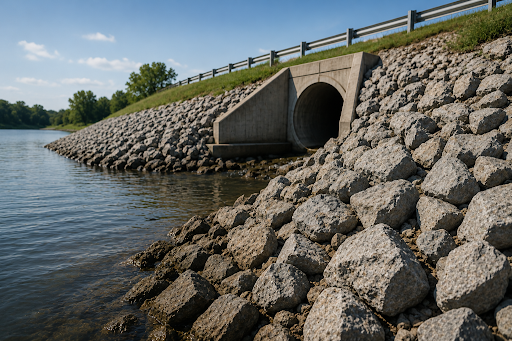
Drive along almost any California highway where a slope meets a waterway, and there's a decent chance you'll see a layer of large, irregular stones lining the bank or channel edge. That's rip rap, and while it might look like someone just dumped a pile of rocks, there's real engineering logic behind how it works and where it gets placed.
This blog covers why rip rap rocks have become one of the more reliable tools in civil engineering, what problems they solve, and where they tend to show up most. Western Materials supplies rip rap and erosion control rocks to projects across California, with the material knowledge to match the right specification to the job.
What Rip Rap Actually Does
Rip rap is about holding a hillside or shoreline that water or gravity would prefer to take away. As water flows through a channel or along a riverbank or coastline, it carries energy, and that energy is transmitted to the soil or substrate that it touches.
Eventually, that transfer loosens particles, shifts them downstream, and slowly eats away at anything resting on top of the washed-away patch. Rip rap stone absorbs and disperses that energy before it gets to the underlying material. The mass of the rock acts as a counterforce to movement.
Individual stones have irregular shapes, which causes them to create friction against each other, and thus the entire layer stays pretty much locked together instead of sliding around piece by piece.
Erosion Control Along Banks and Channels
Bank erosion mitigation is probably the most common reason rip rap gets specified. River banks, stream channels, and drainage channel protection applications all deal with the same basic problem: moving water wearing away the edges of whatever it's flowing past. Rip rap installation along these areas creates a sacrificial armor layer that takes the energy of the water rather than letting it reach the soil. The rock armor doesn't stop water from flowing; it just changes where the energy goes.
Drainage channel protection is a related use case that shows up frequently in civil and municipal projects. Lined channels carry stormwater or irrigation runoff at velocities that unprotected soil couldn't handle without significant surface erosion control challenges. Rip rap gives those channels a surface that can take the flow without breaking down.
Slope Stabilization and Rock Slope Protection
Slopes fail when the forces pushing material downhill exceed the resistance holding it in place. Water is usually involved, either saturating the soil and adding weight or running across the surface and carrying particles away. Rock slope protection using rip rap addresses both pathways. The stones reduce the velocity of surface runoff before it can build enough energy to detach soil particles and begin sediment transport downslope. They also add mass to the slope face, which can improve stability in certain configurations.
Toe protection is a specific application within slope work that's worth mentioning separately. That toe, like the very bottom of a slope where it bumps into a channel or some fairly flat stretch, is often the spot that's a bit too vulnerable. The water tends to move faster there, so scouring and undercutting that little area can start trouble for everything sitting above it. So, if you set rip rap right at that toe intersection, you kind of intercept the issue before it spreads up the slope, and it holds better.
Shoreline Protection
Coastal and lakeshore erosion control solutions often rely on rip rap because the wave energy involved is substantial and consistent. Shoreline protection using rock armor has a long track record in civil engineering because the material is available in sizes that can handle significant wave impact, it doesn't corrode or degrade the way some engineered alternatives do, and it can be placed and repaired with standard equipment.
The irregular faces of rip rap stone also help break up wave energy rather than reflecting it back into the water, which can actually reduce erosion further along the shoreline.
Sediment Retention and Water Quality
One of the not-so-obvious benefits of rip rap is, really, what it does for sediment holding. When erosion is left unchecked, the particles that wash away don't simply vanish, they kinda end up in waterways where they mess with water quality, clog drainage infrastructure, and can even bruise aquatic habitats.
Controlling soil loss prevention at the source keeps that sediment where it belongs. Rip rap achieves this by reducing the surface erosion that starts the whole process, which has downstream benefits that extend well beyond the immediate project site.
Erosion resistance over time is another practical advantage. Unlike some erosion control methods that degrade with UV exposure or biological activity, properly sized and placed rip rap holds its function for decades with minimal intervention. It's a material that generally improves at blending into its environment over time without losing its effectiveness.
Getting the Specification Right
Rip rap isn't a single product. The appropriate size, gradation, and rock type depend on the velocity of water being managed, the slope angle, the underlying material, and how the installation will be accessed for any future maintenance. Under-sized rock gets displaced by flows it was supposed to resist. Poorly graded material has gaps that allow fine soil material to pass through and wash out from behind the armor layer. Getting those details right at the specification stage is what separates a rip rap installation that lasts from one that needs to be redone after the first heavy rain season.
Western Materials carries rip rap rocks and civil engineering materials suited to a range of project scales across California, backed by decades of experience helping contractors and engineers match aggregate specifications to real site conditions.
Planning an erosion control or slope stabilization project?
Contact Our Team Today
Frequently Asked Questions
What are rip rap rocks, and why are they used in civil engineering?
Rip rap rocks are big , sharp, angular stones set along slopes, embankments, and shorelines to limit erosion and keep the soil from shifting due to moving water. In civil engineering, they're often used because of their long life, strong erosion resistance, and their capacity to take in hydraulic energy. Western Materials offers rip rap throughout California, helping with drainage, hillside , and waterfront protection efforts, both small and large-scale ones .
What size rip rap stone is needed for erosion control?
Size depends on the water velocity and the type of application. Faster flows and larger channels generally require heavier, larger rock to resist displacement. Smaller gradations tend to work better for lower-velocity drainage or surface erosion uses, and honestly, it’s one of those things you notice later. Matching the stone size to the site conditions is among the most important steps for a rip rap placement to actually behave and last over time. If you get that part wrong, everything else feels kinda off.
How is rip rap different from regular landscaping rock?
Rip rap stone is specifically graded and sized for erosion control in structural contexts , not really for looks or “just decoration”. It usually ends up heavier , more jagged, and kind of angular, and it gets picked because it survives well when water is doing its hydraulic thing . Regular landscaping rock, on the other hand , is mostly selected for appearance , and it isn’t engineered to take the same sort of loads, the water velocity effects, or the long-term exposure that civil engineering projects bring into the picture.
Can rip rap be used for both bank erosion mitigation and shoreline protection?
Yes, it’s kind of one of the reasons rip rap gets used all across civil engineering stuff. Like the same material principles still hold, even if you’re safeguarding a river bank, lining a drainage channel, or guarding a coastal shoreline. The sizing and how it gets placed will vary based on the energy level involved, but the basic logic of taking rock armor and using it to intercept, then disperse hydraulic energy, remains basically the same from one place to the next.
Does rip rap require maintenance after installation?
Rip rap generally needs less maintenance than a lot of other erosion control solutions; that’s part of why people like it. Still, doing a quick look after major storm events is a good practice, just to see if anything has shifted or if there’s settlement, especially around the toe of slopes, or where the water runs fast in channel sections. If you notice openings or kind of thin areas, then bringing in extra stone or aggregate to reestablish the proper gradation and depth brings everything back to full performance again.
.avif)
Materials management and founders
have produced and supplied high quality
sand and gravel to contractors &
aggregate users across California.
.svg)
.svg)


