.png)

What Role Does Gravel Size Play in Erosion Control?
Published on:
September 7, 2026
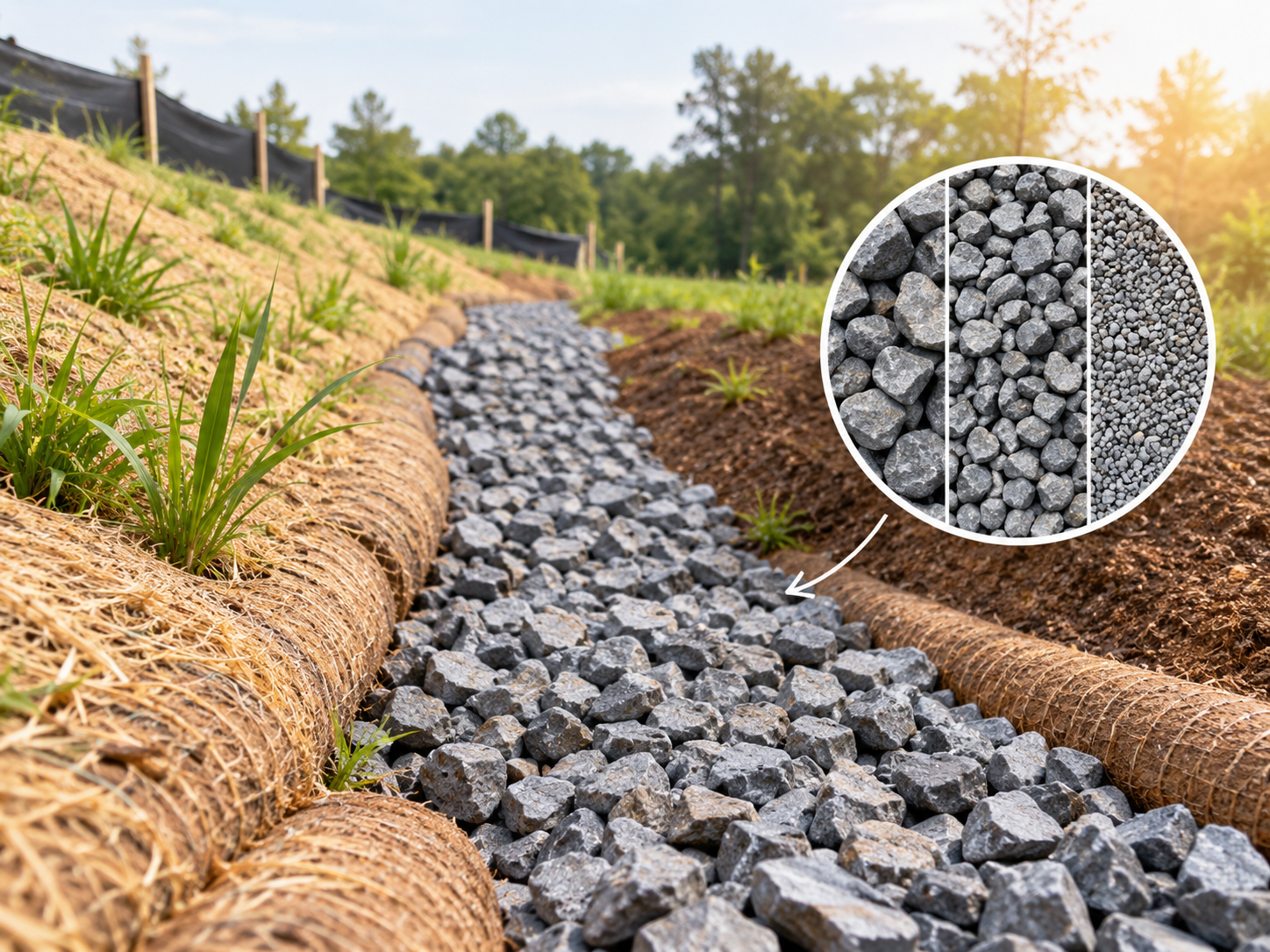
Excessive water runoff will erode exposed soil at a rate much faster than what most property owners can imagine. From a cut into a hillside after the rains have stopped, to the deepening ditch, or the culvert outlet now being a mud pit, it’s all about weight, form, and gravity.
Choosing an appropriate aggregate involves much more than randomly throwing crushed rocks on the soil and wishing for the best. The use of gravel for erosion control is because the physical structure of the ground cover becomes strong enough to hold up against the water movement, but the physical nature of the rock determines whether it will move with the water.
At Western Materials, with decades of supplying rock, crushed base, and aggregate across California job sites, we see projects succeed or fail based solely on stone gradation. This guide walks through the exact mechanics of stone grading, how rushing water pulls at loose ground, and how different stone sizes keep slopes, ditches, and channels intact.
Why Aggregate Grading Dictates Surface Stabilization
Water moving over bare earth exerts a drag force along the surface. If the energy of the runoff exceeds the resting weight of the aggregate covering the soil, the water picks up those stones and carries them downstream.
That is why particle diameter matters so much. A light pea gravel layer might look clean on a landscape walkway, but run even a moderate sheet of surface water over it, and the stones will float and tumble down the incline. Larger fractured rocks stay grounded because their individual mass resists the lifting force of the current.
Gradation also determines how stone particles sit against one another. A single uniform size leaves consistent voids, allowing water to slip straight through and pull underlying fine dirt out from beneath the rocks. A properly mixed gradation, combining mid-size rock with smaller angular fragments, packs tight. The varied dimensions close off internal pathways, creating aggregate interlock between the stones and locking the entire layer directly against the subgrade.
Countering Hydraulic Shear Stress on Slopes and Incline Beds
When water flows downhill, it does not just fall forward; it drags against the channel bottom and sides. This friction creates hydraulic shear stress, the sliding pull that tries to rip soil and stone right out of the riverbed or drainage line.
“Steeper drops and deeper water levels spike this shear stress dramatically, which is why hydraulic velocity plays such an important role in rip rap selection:
- Shallow gradients: Low-velocity runoff creates minor surface drag. Standard crushed rock varieties between three-quarters of an inch and an inch and a half can manage these conditions without budging.
- Moderate swales and roadside cuts: Moving water concentrates into a defined stream, multiplying bottom shear. Stone in the two-to-four-inch bracket creates the necessary bed roughness to push back against the water's dragging motion.
- Steep cuts and stormwater spillways: As velocity jumps, high-energy runoff tears right through standard decorative rock. These sections demand heavy erosion control stone that provides the raw anchoring weight needed to cancel out severe downward drag.
If the aggregate mass is too light for the shear stress generated by the terrain, the flow will strip the bed clean down to hardpan or bedrock.
Protect your property with the right gravel size.
Get Erosion Control Rock
Building Lasting Scour Resistance at High-Energy Discharge Points
Culvert mouths, downspout exits, retention pond inflows, and curb cuts create another serious issue: concentrated discharge. Water leaving a pipe drops into an open swale with high velocity and turbulent swirling action. This churning force carves deep plunge pools, a destruction process known as scour.
Achieving dependable scour resistance in these zones requires stepped aggregate sizing:
- The direct impact point requires heavy, angular erosion control rock, typically categorized as rip rap ranging from six inches to upwards of twelve inches or larger. As the water smashes into these large stones, the open, broken faces shatter the focused stream into small, disorganized ripples. This dispersion bleeds off the kinetic energy before the current touches vulnerable soil.
- Just downstream from the splash basin, the stones can taper down in size as the water transitions into a calmer, slower sheet flow. Using oversized rock at the discharge head and tapering down across the transition apron prevents the surrounding banks from being undercut and washed out from behind.
Prevent costly re‑grading with durable aggregate.
Request Gravel Delivery
Matching Stone Diameters to Real-World Ground Conditions
Not every property needs boulders, and small gravel has clear limits. Choosing the correct size depends strictly on slope angle and water volume.
Small Crushed Aggregate (3/4-inch to 1.5-inch)
This size works best on flat yard spaces, subtle lawn swales, and light landscape slopes under three-to-one grades. It packs smoothly, slows down light sheet wash from rain showers, and stays in place as long as the water does not channel into a fast-running stream.
Coarse Fractured Rock (2-inch to 4-inch)
Often used for drainage ditches, driveway borders, and construction site track-out tracking pads. The individual pieces are too heavy for regular rainwater runoff to dislodge. The rough, irregular corners bite into neighboring stones, forming a cohesive mat that resists vehicle pressure and steady runoff, which is one reason angular gravel generally performs differently from rounded gravel in erosion-prone areas.
Heavy Rip Rap and Cobble (6-inch to 12-inch and above)
This heavy stone belongs on steep hillside cuts, shorelines, creek banks, and drainage swales carrying storm runoff. It serves as an immovable armor layer capable of withstanding fast-moving, debris-filled stormwater without shifting out of place.
Plan Your Site Drainage with Trusted Aggregate Materials
Erosion control projects require real, dense aggregate built to withstand heavy weather. Guessing on sizing often leads to blown-out slopes, ruined landscape beds, and costly re-grading work after the next major storm. When sourcing dependable materials for hillsides, driveways, or commercial channels, partnering with Western Materials gives you access to a complete selection of high-yield crushed rock, base, and rip rap.
If you are searching for a dependable gravel supplier near me in Orange County LA , reach out to our team to get the right grade delivered straight to your job site.
Frequently Asked Questions
Why is gravel used for erosion control on slopes and swales?
Gravel as an erosion control method offers quick weight and abrasiveness to the exposed surfaces. It has a lot of weight and is angular in nature; this makes water slow down, and it protects the fine sediment from the force of rainfall, thus preventing gully formation.
What size rock is best for handling heavy stormwater runoff?
Large stormwater runoff demands a heavy-duty mix of coarse stones, between four and eight inches, and large rip rap, eight to twelve inches. The larger stone has sufficient weight to withstand fast-moving water without getting dislodged.
Can I use smooth river rock instead of crushed gravel for erosion control?
River rock does not have a good reputation in terms of usage on a steep slope because its surface cannot lock onto anything like crushed stone. As a result, water is able to carry it away rather easily.
Why do I need landscape fabric under erosion control stone?
The geotextile fabric is a stabilizing layer separating the subsoil from the rock layer. The purpose of the geotextile fabric is to stop the flowing water from pulling up fine soil through the rock pores as well as preventing the larger aggregates from penetrating the soft mud below.
How does stone roughness slow down moving water in a ditch?
Irregular stone surfaces provide friction to the sides and base of the drainage trench. Such frictional resistance prevents the water from flowing smoothly in its course and reduces the flow into eddies with very little erosion capacity.
.avif)
Materials management and founders
have produced and supplied high quality
sand and gravel to contractors &
aggregate users across California.
.svg)
.svg)


