

What Is the Los Angeles Abrasion Test and How Does It Work?
Published on:
November 16, 2026
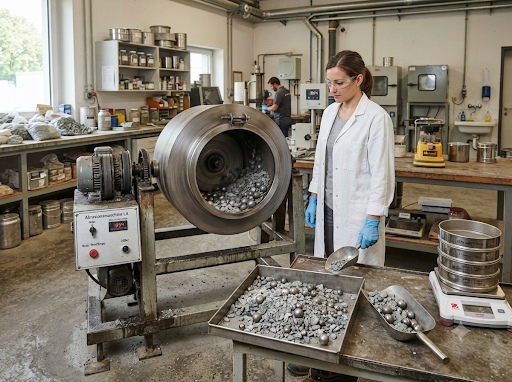
Ever noticed how some driveways, road bases, and drainage layers stay solid for decades, while others crack and crumble within a few years? Very often, the answer starts with the rock itself. Before an aggregate goes into a project, engineers want to know whether it can handle heavy loads, constant traffic, and rough handling, which makes aggregate hardness an important part of material selection.
That proof usually comes from the Los Angeles abrasion test. In this guide, we break down what the test is, how it works, how to read the result, and why it matters for your next build.
What Is the Los Angeles Abrasion Test?
Los Angeles Abrasion Test is a laboratory technique that helps to determine the resistance of crushed stones, gravel, and other coarse aggregates against wearing, impact, and grinding actions. It is one of the most commonly performed aggregate abrasion tests in construction, and it is frequently referred to as an aggregate abrasion resistance test. Popular guidelines include ASTM C131 and AASHTO T 96.
On a construction site, aggregate is crushed by the weight of the truck tires on top of it, and this crushing action happens daily. Fragile aggregates crumble into dust and fine materials, weakening the whole layer, which is why construction rock quality matters so much in projects that need long-lasting results.
This test simulates such crushing conditions within the laboratory, so one can know how a material behaves before it arrives at your construction site.
How Does the Los Angeles Abrasion Test Work?
The process is easier to follow than most people expect. A lab team starts with a clean, dry sample of aggregate and separates it into specific size groups through sieving, much like the process used in aggregate sieve analysis. Those groups are weighed and combined to match a set grading, usually around 5,000 grams for a standard sample.
Next, the sample goes into a hollow steel drum along with a set number of steel balls, known as the charge. The number of balls depends on the grading, anywhere from six to twelve. A shelf inside the drum lifts the stones and balls, then drops them as the drum turns. The drum spins at roughly 30 to 33 revolutions per minute for 500 turns, so the aggregate keeps getting smashed and ground.
Once the drum stops, the technician pours out the material and passes it over a 1.70 mm (No. 12) sieve. The pieces that stay on the sieve are washed, dried, and weighed. Everything that broke down and passed through counts as loss. The more material that wears away, the weaker the aggregate.
How to Read the Los Angeles Abrasion Value (LAAV)
This number is referred to as the Los Angeles abrasion value (LAAV). It is merely the percentage weight loss in the process. To determine the Los Angeles abrasion value, the weight difference is divided by the initial weight, then multiplied by 100.
Here is an easy way to understand this. Let’s assume that you started with 5,000g but only 4,000g remains in the sieve. This means you have 1,000g weight loss, which means 20 percent LAAV.
A lower value means a tougher, more durable stone, but abrasion resistance is only one part of aggregate performance, alongside aggregate density, gradation, and compaction. As a rough guide, numbers under 30 percent usually point to strong aggregate, while higher numbers suggest softer material that may break down faster. Limits differ from one agency and project to another, so always check your plans and specifications for the exact maximum allowed.
Need aggregate that meets your project specs?
Get a Quote
Why Aggregate Abrasion Resistance Matters
The resistance to abrasion by aggregates affects the duration of service of a finished structure. Poor quality aggregates in the road base can lead to ruts and settlement under repeated mechanical loads, while proper compaction also helps maintain road base performance. Driveways might become dusty and uneven. Drainage layers can become clogged by the broken pieces that block the pores designed for water to flow.
On the contrary, durable aggregates maintain their integrity under mechanical loads, retain the compact structure, and do not require future repairs. This is beneficial for both contractors and homeowners as it allows for planning in advance and saves money.
What Affects a Los Angeles Abrasion Value?
A number of factors play an important role in determining the outcome. The most significant factor is the kind of rock. Rocks that are dense and hard, like granite and basalt, generally rate higher than soft rocks like some types of limestone and weathered sandstone.
The shape of particles and the process of crushing also affect the rate of attrition. Flatter particles tend to break more easily than cubical ones, which is another reason aggregate flakiness deserves attention when checking material quality. The presence of internal cracks, the porosity of rocks, and the crushing and screening processes of a quarry all may influence this figure.
Limits of the Aggregate Abrasion Test
The test is useful, but it does not tell the whole story. It is a quick way to compare materials, yet it cannot predict exactly how a particular stone will behave in every climate or load condition. Smart engineers pair it with other checks such as sieve analysis, soundness testing, specific gravity, and absorption. Together, these results give a far clearer picture of overall quality than any single number can.
Building in the Valley?
Order sand, gravel, and base materials Today!
How to Choose the Right Aggregate for Your Project
Choosing the correct aggregate is made much easier if you know how to question. First, make sure that you get the right aggregate for the work. The driveway, retaining wall, and road base each require materials with different strength and durability requirements, so choosing the right aggregates for site preparation is an important first step.
Then, ask the supplier to give you the latest test results, which should include LAAV, grading, and other details you need.
Lastly, ensure that the aggregate that gets delivered matches that of the test one and that the supplier delivers in good time. A good supplier will gladly answer your questions.
Conclusion
The Los Angeles Abrasion Test provides developers with a concrete means of assessing the hardness of an aggregate. Through the measurement of weight loss during the rotating drum process, it helps convert the vague concept of material toughness to a quantifiable one. The lower the LAAV, the higher the aggregate abrasion resistance of the material used, thereby extending its life. If you are in search of high-quality sand and gravel in the San Fernando Valley, then Western Materials, with over four decades of experience, is your answer.
Frequently Asked Questions
What is the Los Angeles abrasion test used for?
The LA Abrasion Test measures the wear resistance of coarse aggregate. It allows engineers to know if the aggregate is suitable for use as base, concrete, or driveway aggregate. In doing so, it ensures that no weak aggregates are used to cause cracking, dusting, and failure of pavement structures.
What is a good Los Angeles abrasion value (LAAV)?
The lower the LAAV, the more difficult the aggregate is. The number should be below 30 percent to indicate strong stone. The exact percentage limit depends on the project requirements of the concerned authority. Thus, it is necessary to find out the maximum permitted LAAV before purchasing aggregate for your construction.
Is the aggregate abrasion test the same as the Los Angeles test?
For the most part, yes. Aggregate abrasion test is generally used as an all-encompassing term, while Los Angeles abrasion is the one type that is widely used in coarse aggregates. There are other types of abrasion testing, like Micro-Deval testing; however, the Los Angeles test is the one that everyone recognizes.
What affects aggregate abrasion resistance?
Type of rock is the most important variable, as a hard rock such as granite or basalt wears less than soft rock. Variables include weathering, fractures in the rock, porosity, shape of the particles, and the crushing process. The cubical or properly shaped particles have a higher resistance to abrasion in the drum test.
Can I ask my supplier for abrasion test results?
Absolutely, and you definitely should. An honest supplier will be able to provide you with recent testing results, which include the LAAV and gradation, which will allow you to see that your aggregate is suitable for your construction project. If you ask about it beforehand, you will have no unpleasant surprises during your construction process.

Materials management and founders
have produced and supplied high quality
sand and gravel to contractors &
aggregate users across California.


