.png)

What Is the Importance of Fineness Modulus in Construction Sand?
Published on:
June 30, 2026
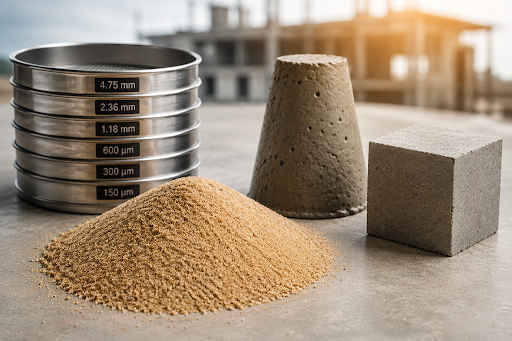
Sand looks simple until you start asking why one batch of concrete behaves differently from another mixed with the same proportions. A lot of the time, the answer is in the sand itself, specifically in how its particles are distributed across different sizes. Fineness modulus is the number that captures the distribution in a single value, and understanding what it means in practice is one of those things that separates contractors who consistently get good results from those who keep chasing problems through mix adjustments.
This blog covers what fineness modulus actually tells you, why it matters for construction grade sand, and how it connects to the broader decisions around aggregate selection. Western Materials supplies construction sand and aggregates across California with the kind of grading consistency that makes a real difference in how materials perform on site.
What Fineness Modulus Actually Measures
Run a sand sample through a standard set of sieves and record how much material stays on each one. Add those cumulative retained percentages together and divide by one hundred. That's the fineness modulus calculation, and the number you end up with tells you where the sand sits on the scale between fine and coarse.
Most construction sand used in concrete work lands somewhere between 2.3 and 3.1. Lean toward the lower end, and you've got finer material. Push toward the upper end, and the particle size spectrum is shifting coarser. Neither direction is automatically wrong, but yes, both bring consequences.
Finer sand tends to give you more surface area so the cement paste can coat it, and that sort of thing will pull more water into the mix. Coarser sand cuts into workability a bit , and then the finishing step can be tougher . The fineness modulus basically tells you where the sand is, before you lock in a mix design , which is precisely when that info is most useful.
The Gradation Curve Behind the Number
Here's something worth knowing. Two sand samples can produce the same fineness modulus while having completely different internal distributions. One might spread material smoothly across the particle size spectrum, filling voids efficiently at every size fraction. The other might have gaps at certain sizes that leave voids that no other particle fills. The number looks the same. The behavior in a mix doesn't.
This is why fine aggregate grading gets checked against a grading envelope rather than just the modulus value alone. The gradation curve shows cumulative retained percentages at each individual sieve size, and gradation compliance means those values all land within acceptable limits ,not just that the overall average turns out right. Sand that seems to pass the fineness modulus check but still sits outside the grading envelope at a few sieves can keep bringing workability issues or uneven results in the finished concrete.
How Grading Connects to Real Concrete Behavior
Concrete sand grading touches several things that matter practically on a job. Water demand is one of the more direct connections. Sand with too many fines needs more water to reach workable consistency, and more water means lower strength and more shrinkage as the concrete cures. Void content is another. Sand that fills the aggregate distribution efficiently across size fractions leaves less space for cement paste to fill, which reduces the paste volume needed and improves overall density.
Finishing is where concrete sand grading becomes visible to anyone working on the slab. Too fine, and the surface bleeds and crusts before you're ready for it. Too coarse, and the mix feels harsh and drags under the trowel. A sand that sits in the right part of the grading envelope gives you a mix that places, finishes, and cures the way the design expects, without fighting you at every step.
Consistent sand grading starts with the right aggregate supplier.
Call us now
When Blending Becomes the Answer
Natural sand deposits don't always produce material that fits neatly within specification limits. Sometimes the available source is close, but gaps at certain sieve sizes push it outside the grading envelope in ways that matter. Aggregate blending is how that gets resolved. Combining two sands with different particle size spectrums can produce a combined gradation that neither source achieves alone.
Aggregate proportioning in this situation means working out the right ratio of each source material so the combined cumulative retained percentages land within the target grading envelope at every sieve size. It's more common than it sounds, particularly in regions where natural sand sources have consistent characteristics that don't always line up with what a mix design needs.
Why Consistency Between Deliveries Matters
A mix design calibrated to one sand batch doesn't automatically transfer to a different batch with a shifted fineness modulus. Building sand specifications exist partly for this reason. If the sand coming onto a job changes in its aggregate distribution between loads, the mix behavior changes with it, and adjustments have to be made to bring things back into line. Catching that drift early through regular fineness modulus checks prevents problems from compounding before anyone notices something is off.
Even a shift of 0.2 in fineness modulus can affect water demand and consistency enough to show up in the finished concrete. For high-specification work, that's not a minor concern.
Western Materials supplies construction-grade sand to contractors across California with grading consistency that holds batch to batch. Whether the work involves standard structural concrete, specialized mix designs, or applications where fine aggregate properties need to meet tight specification limits, the team at Western Materials can help identify material that fits what the project actually needs.
Get construction sand with the grading consistency your project demands.
Request a Quote Today
Frequently Asked Questions
What is fineness modulus, and why does it matter for construction-grade sand?
Fineness modulus is an index number obtained from sieve analysis , and it kind of shows how fine or coarse a sand sample is in general. For construction-grade sand that goes into concrete, it helps forecast the water demand, the workability, and basically how the mix will act.
Western Materials offers construction sand with steady grading across California so contractors get dependable mix performance, even from one delivery to the next , without too much surprise.
What is a good fineness modulus value for concrete sand grading?
For most standard concrete uses, a fineness modulus around 2.3 to 3.1 is usually okay, and honestly, you can get away with that quite a lot. You’ll often see values roughly 2.5 to 2.9 showing up in typical mixes, but the proper figure really depends on how the whole mix is put together and what the job is actually asking for. If the application is more coarse or less sensitive, higher values can be tolerated, but when you need better workability, or a smoother finish quality , then it helps to have the sand sitting closer to the middle of that band.
How does fine aggregate grading affect concrete strength and workability?
Sand that drops outside the target grading envelope, in either direction, kind of upsets the mix balance. If it is too fine, then the water appetite goes up, and well, that tends to weaken things, plus it also boosts shrinkage after it cures.
If it is too coarse, then the whole blend loses cohesion and ends up being a lot trickier to place and still finish properly. Keeping the fine aggregate grading consistent lets the mix behave in a more steady, predictable way, and that really matters across every single batch on a project.
What is aggregate blending, and when is it needed?
Aggregate blending is like you mix two or more sand sources that have different gradations, so you end up with a combined particle size distribution that actually matches the specification requirements.
This idea usually shows up when one sand supply has gaps in its gradation curve, or when it kind of sits outside the grading envelope at certain sieve sizes. Then, doing proper aggregate proportioning for the blend makes sure the resulting material behaves the way the mix design expects, instead of acting a bit strangely.
How often should fineness modulus be tested during a construction project?
For consistent production work, checking the fineness modulus of incoming sand at regular intervals, or whenever the source or the delivery batch changes, is a reasonable practice.
Small drifts in the gradation curve can alter water demand and mix behavior more than they seem to on paper. Catching those changes before they show up in the finished concrete is always easier than tracking down the reason after something goes wrong.
.avif)
Materials management and founders
have produced and supplied high quality
sand and gravel to contractors &
aggregate users across California.
.svg)
.svg)


