.png)

What Is the Difference Between Density, Gradation, and Compaction in Aggregate?
Published on:
September 24, 2026
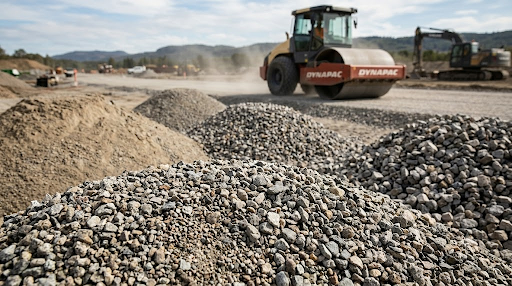
When working on civil groundwork, paving a sub-base, or batching concrete, you will hear engineers and site managers throw around terms like density, gradation, and compaction almost interchangeably. While they are closely linked in day-to-day earthwork, they describe three distinct mechanical behaviours. Confusing these terms or treating them as identical can lead to under-compacted bases, poor drainage, sudden post-construction settlement, or excessive material cracking under vehicle traffic. Understanding fundamental aggregate properties gives contractors and project owners better control over how stone, gravel, and materials such as construction grade sand behave once they are placed, mixed, and compacted.
This practical breakdown will guide us through the meanings of density, grading, and compaction in construction, their relationships, and the reasons why getting them balanced correctly avoids structural problems in the future. At Western Materials, we offer contractors, civil engineers, and landscapers top-quality crushed stone, base materials, and washed aggregates that have been created based on exacting specifications for performance. The following is what every builder needs to know about these critical characteristics.
1. Defining Aggregate Density: Mass, Volume, and Internal Pores
At its core, density refers to the amount of rock mass that can fit into a given volume of space. However, in civil engineering, the stone material will never be solid rock; there will be tiny cavities on the inside of the stone and on its surface. Therefore, density tests have various criteria:
- Specific Gravity: This is the ratio of the weight of the mineral solid to that of water. The specific gravity of granite or basalt stone is higher than that of the lighter vesicular volcanic rock or porous limestone.
- Bulk Density: Usually known as unit weight, it is defined as the weight of the aggregate in its container, taking into consideration not only the weight of the stone but also the air spaces in between.
- Loose vs. Compacted Bulk Density: The gravel in the haul truck bed will be loose with maximum air voids in between the stones, but when rodded or tamped in a test container, the density will increase.
Density directly impacts how many tons of stone you need to order to fill a trench or form a stable structural footing.
2. Understanding Aggregate Grading: Particle Sizes and Void Distribution
Gradation, or aggregate grading, does not measure weight; it measures particle size distribution, and understanding how aggregate gradation of sand and gravel affects compaction is essential when designing a stable base. In standard lab procedures, a dried aggregate sample passes through a stack of progressively smaller wire sieves, from coarse two-inch screens down to fine No. 200 mesh sieves.
How those particle sizes distribute across the sieves defines the aggregate profile:
Well-Graded Aggregates
A well-graded mix contains an even, continuous spread of particle sizes—from larger stone down to mid-sized gravel and fine sand. The small-sized particles fit perfectly into the spaces between the big rocks. The tight fitting ensures there are no pockets of air and low permeability, which makes it ideal for use as a road base or construction foundation.
Gap-Graded and Uniformly Graded Mixes
In contrast, a uniformly graded sample contains stones of almost identical size (such as single-size drainage gravel). Because there are no smaller sands or fines to fill the spaces, large open voids remain. While this is deliberately chosen for French drains, retention trenches, and permeable pavements to let water run freely, it offers lower raw bearing stability on its own compared to a well-graded crushed base.
Grading curves also govern how easily stone resists mechanical forces; when particle sizes interlock cleanly, they work alongside raw aggregate abrasion resistance and the rock's aggregate crushing value to stop individual pieces from snapping under heavy plant machinery.
Need Help Choosing the Right Base Gradation for Your Site?
Speak with a Materials Specialist
3. The Role of Compaction: Turning Loose Stone into a Solid Structure
If density is the material's weight per volume and gradation is its spread of particle sizes, Compaction is the physical effort applied on-site to press everything together, so knowing how to compact crushed stone correctly for maximum strength is essential when preparing a load-bearing base.
When an excavator or dump truck spreads a layer of road base, that lift is full of loose air pockets. Compaction uses mechanical energy through smooth-drum vibratory rollers, pneumatic tyre rollers, or plate compactors to drive out trapped air, and proper compaction affects road base material performance by improving stability and reducing settlement.
Compaction changes the field state of the aggregate in three important ways:
- Eliminating Air Voids: Driving out loose air increases the dry unit weight of the lift, bringing it closer to its maximum achievable laboratory density.
- Developing Shear Resistance: As stones wedge against one another, aggregate interlock and internal friction increase, helping the base resist shifting under heavy loads. This friction stops the sub-base from shifting or spreading laterally when loaded by semi-trailers or concrete slabs.
- Controlling Future Settlement: Uncompacted or poorly rolled aggregate will naturally consolidate under repeated vehicle traffic, leading to depressions, rutting, and asphalt cracking.
4. How Density, Gradation, and Compaction Work Together
These three properties are not isolated line items on a test sheet; they rely on each other to produce a reliable civil sub-base or pavement course:
- Grading Sets the Limit for Compaction: You cannot compact a single-size, uniform round gravel into a dense, impenetrable pad because there are no intermediate sizes or fine particles to close the open voids. The grading curve dictates the highest density the roller can achieve.
- Compaction Realises Maximum Bulk Density: A perfectly blended aggregate mix dumped loosely will fail beneath a heavy wheel load if it never receives adequate roller passes. Compaction is the action that takes potential density from a test report and turns it into real-world strength.
- Density Confirms Structural Readiness: Once the rollers finish, technicians run nuclear gauge or sand cone tests to compare on-site density against the lab benchmark. If density hits the specified target (commonly 95% or 98% relative compaction), the base is cleared for paving.
Sourcing Bulk Aggregates, Crushed Rock, or Soil?
Request a Fast Material Quote
Final Thoughts: Quality Aggregates Build Reliable Foundations
The balance between aggregate properties and site preparation plays a major role in crushed aggregate base (CAB) in pavement longevity, particularly when the material must withstand repeated traffic. Understanding the relationship between density, particle size, and mechanical compaction helps to avoid shortages, settling problems, and tear-outs of the pavement.
At Western Materials, we take the guesswork out of sourcing your site materials. Whether you need Caltrans-spec crushed rock, clean drainage stone, or premium construction grade sand, our team provides consistently graded, laboratory-tested products to keep your jobs moving forward on solid ground.
Frequently Asked Questions
1. What are the key aggregate properties that dictate structural stability?
The important qualities of the core aggregate include density, particle shape, grading curve, crushing value, and durability, all of which contribute to the overall quality of construction rock. These characteristics determine the capability of the core aggregate to create a closely packed layer with low voids to support the weight of wheels and withstand excessive water seepage and settlement.
2. Can you compact single-sized gravel?
Single-sized gravel does not compact in the traditional sense because it lacks smaller sand and fines to fill the spaces between rocks. Rolling seats the stones together, but the lift retains significant air voids. This open structure is ideal for drainage, though not for high-load pavement layers.
3. Why is moisture so important when rolling an aggregate base?
The presence of water can change how easily rock fragments move together under roller pressure, which is why sand moisture affects material quantity and performance during material handling and placement. Too much dryness leads to internal friction and therefore inadequate consolidation, while too much moisture causes the water trapped between the rock fragments to push them apart.
4. What is the difference between open-graded and dense-graded base?
Dense-graded base uses a mixture that ranges from large stones to small stone dust and is made to pack tightly, forming an impervious base. Open-graded base uses only larger stones to create spaces for the rapid drainage of subsurface water.
5. What test verifies that compaction meets site specifications?
Technicians typically verify compaction using a nuclear density gauge or a traditional sand cone test. These methods measure the dry density and moisture levels of the compacted lift in place, comparing the readings against the project's laboratory-determined maximum dry density established by a Proctor test.
.avif)
Materials management and founders
have produced and supplied high quality
sand and gravel to contractors &
aggregate users across California.
.svg)
.svg)


