.png)

What Is Flakiness Index in Construction Aggregates?
Published on:
August 28, 2026
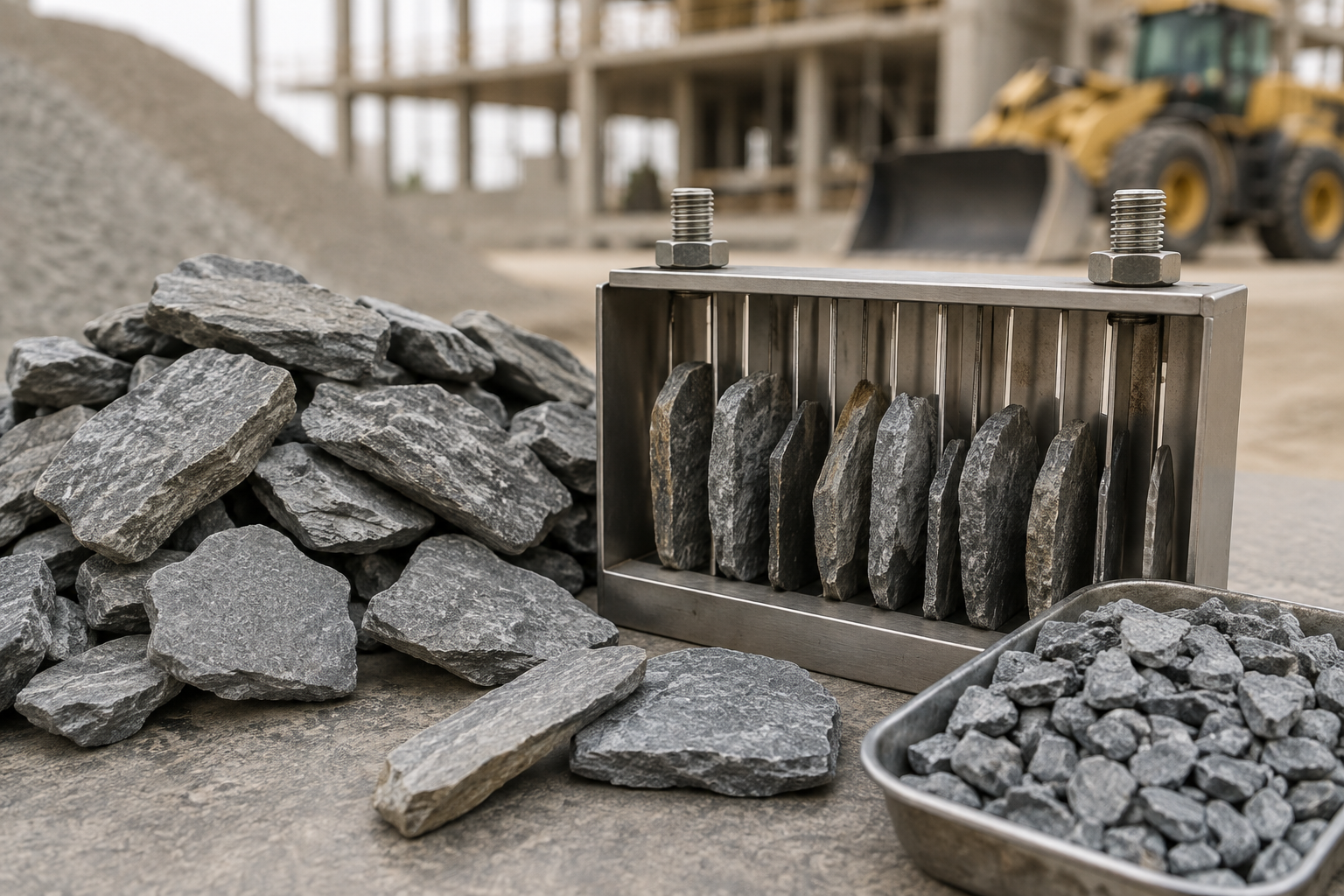
Ever wonder why some roads crumble while others last for decades? It usually comes down to the quality of the rocks inside the concrete. If you pick up a handful of gravel, you’ll notice they aren’t all perfect cubes. Some are thin, flat, and weak. We call these troublemakers "flaky," and they cause major headaches on a job site. That is where the Flakiness Index comes into play. Professionals at Western Materials know that getting the shape of your stone right is just as important as getting the right mix. Let’s break down why shape matters.
Why Particle Shape Analysis Matters
When you are building something, you want materials that stack together like a solid puzzle. If your stones are thin and flat, they don't lock together well, which can reduce aggregate interlock and create gaps in the pavement. They tend to break easily under pressure, leaving gaps in your pavement.
- Weak stones crack under heavy traffic loads.
- Flat pieces create voids that suck up way too much expensive asphalt.
- Poorly shaped rock leads to faster structural failure over time.
- Uniform shapes ensure your base remains stable for years, especially when crushed stone is compacted properly.
How We Handle the Flakiness Test
Engineers use a specific sieve method to sort the good from the bad. It’s a simple process, but it tells us a lot about the strength of the batch. You basically pass the rock through a slotted gauge.
- Stones that pass through the slot are considered thin.
- The weight of these thin stones is divided by the total weight.
- This calculation gives us the final percentage for the batch.
- If the number is too high, the batch doesn't make the cut.
Need help choosing the right material for your next build?
Talk to a Material Expert
The Role of Aggregate Flakiness
You might think rock is just rock, but that’s a rookie mistake. If you have excessive amounts of flaky aggregates in your mix, you will end up with concrete that has no strength at all. Imagine building a wall with fragments of glass and not bricks.
- Low index scores indicate a high-quality, crush-resistant material.
- High index scores mean the material is prone to breaking down.
- Contractors check these stats to save money on long-term repairs.
- Avoiding thin stones saves you from expensive structural failures later.
Why We Watch Aggregate Grading
When we talk about aggregate grading, we are looking at how different sizes fit together and how this affects aggregate gradation and compaction. It’s not just about the size, though. It’s also about how compaction affects road base material performance and ensures the stones can handle the weight of cars, trucks, and equipment rolling over them daily.
- Well-graded mixes have fewer air gaps.
- Proper grading makes concrete easier to pour and finish.
- Consistent sizing is the secret to a smooth, durable road surface.
- Never mix cheap, low-quality stones with your premium supplies.
Comparing Flakiness to Elongation Index
Most people also look at the elongation index when evaluating stone. While flakiness looks for thinness, elongation looks for length, just as angular and rounded gravel differ in how their particle shapes affect interlocking and stability.
- Elongated stones stick out and create weak spots in the mix.
- Combined with thin stones, they can reduce structural stability and weaken the base layer, making the role of crushed aggregate base (CAB) in Pavement Longevity especially important.
- Testing for both ensures you get the strongest possible material.
- Always ask your supplier for lab results on both metrics.
Why Quality Matters for Every Project
No matter whether it is heavy gravel or construction grade sand you are dealing with, quality control is everything that counts. Once poor-quality material is involved, the efforts of even the most professional workers will be of no use. You need a stone that will stand up to pressure.
- Quality rock reduces the amount of cement needed in a mix.
- Stronger aggregates mean you spend less on maintenance in the future.
- Reliable suppliers always provide testing data upon request.
- Don't be afraid to ask questions about where your rock came from.
How We Do Things Differently
At Western Materials, we don't just dump gravel on your site and call it a day. It is evident that your reputation depends on how good the roads and foundations that you lay down are. Our materials will be thoroughly checked before you receive them to ensure that they do not have any structural weaknesses. We take care of your projects as if they were our own projects and ensure that all the stones that we supply are up to the standards.
Ready to source high-quality, reliable aggregates for your project?
Get a Quote Today
Frequently Asked Questions
Q. What is the Flakiness Index for road construction?
At Western Materials, we use the Flakiness Index to ensure road stability. It measures the percentage of thin, flat particles in a rock sample. If the index is too high, the pavement will likely crack under traffic pressure, so we keep these percentages low for safety. This is especially important when selecting materials for a crushed aggregate base, which supports pavement from below.
Q. How does aggregate shape affect concrete strength?
Thin or flat stones act like weak points in a concrete slab. They are prone to snapping when heavy weight is applied. A cubical shape provides the best interlocking properties, which keeps the concrete solid and prevents the formation of internal cracks over time.
Q. Can I perform an aggregate test on-site?
Although a good estimate can be made visually, an exact determination needs the use of a standard gauge of thickness along with a scale. It would be better if the result was confirmed through laboratory testing to meet industry requirements.
Q. Does a high index mean the stone is bad?
Yes, a high score generally indicates poor quality. It means the batch contains too many thin, brittle pieces. These pieces break down under heavy loads, which leads to premature wear, uneven surfaces, and a much shorter lifespan for your concrete or asphalt projects.
Q. How often should aggregates be tested?
You should test materials whenever you source them from a new quarry or when you change your processing equipment. Regular testing keeps your supply consistent, saves you money on potential rework, and ensures you aren't paying for weak material that won't last.
.avif)
Materials management and founders
have produced and supplied high quality
sand and gravel to contractors &
aggregate users across California.
.svg)
.svg)


