.png)

What Causes Uneven Footing in Horse Arenas?
Published on:
June 30, 2026
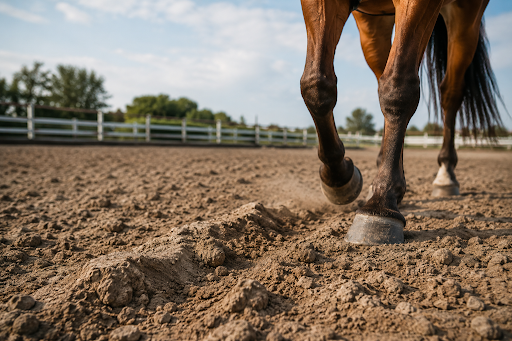
If you've spent any real time around horse arenas, you've probably felt it before you could name it. One corner rides differently from another. The horse hesitates slightly at a certain spot. The footing that felt fine last week has somehow shifted into something unpredictable. Uneven footing in horse arenas is one of those problems that builds quietly until it becomes hard to ignore, and understanding what drives it can save a lot of frustration down the line.If you've spent any real time around horse arenas, you've probably felt it before you could name it. One corner rides differently from another. The horse hesitates slightly at a certain spot. The footing that felt fine last week has somehow shifted into something unpredictable. Uneven footing in horse arenas is one of those problems that builds quietly until it becomes hard to ignore, and understanding what drives it can save a lot of frustration down the line.
This blog covers the main causes behind uneven equestrian sand arena surfaces, what happens when footing breaks down, and how to catch problems before they affect your horses. Western Materials supplies arena-grade sands across California for facilities dealing with exactly these challenges.
Why Footing Unevenness Happens in the First Place
The surface of a riding arena looks simple from a distance. In practice, it's a layered system where several things have to work together, and when one part slips, the rest tends to follow.
Surface Layer Displacement
Heavy, repeated traffic in the same paths is usually where things start going wrong. Horses circle, trainers work the same rail lines, and the arena footing gradually migrates away from the areas of heaviest use. What started as an even spread develops low spots and high spots, and traction consistency drops across the surface.
Corners and fence lines tend to build up material while the centre or rail track thins out. Without regular redistribution through dragging and grooming, this kind of drift compounds over time.
Problems with Footing Stratification
Footing stratification refers to how the layers of an arena separate or settle unevenly over time. A well-built equestrian arena surface has a base layer, sometimes a cushion layer, and then the loose riding surface above it. When these layers stop behaving as a system, the results show up fast. Material fines migrate downward.
Heavier particles stay near the surface. The cushion layer performance becomes inconsistent because it's no longer carrying the load the way it was designed to. When the footing depth uniformity breaks down between sections of the arena, some areas feel harder than others, even if they look the same.
Poor Drainage and Moisture Management
Water changes how arena footing materials behave, sometimes significantly. Dry footing loses its ability to hold shape under pressure. Oversaturated footing compacts and hardens once it dries.
Neither extreme supports good impact attenuation or surface energy return, which are the qualities that protect horses from concussive stress during movement. Arenas without proper base drainage trap moisture unevenly, which creates pockets of inconsistency that are difficult to fix by grooming alone.
Wrong Sand Specification for the Application
Not all sand behaves the same way under load. Rounded particles shift and migrate more easily than angular ones. Very fine sand compacts readily and can crust. Very coarse material stays loose but doesn't offer enough footing shear resistance to support lateral movement confidently.
The wrong sand choice for a horse arena surface can produce unevenness that no amount of dragging will fully correct, because the issue is the material itself rather than how it's been maintained.
Sub-Base Failure
Sometimes the problem is below the surface entirely. A sub-base that wasn’t properly compacted back during construction, or that has started to settle a bit lopsided over time, will show up in the footing layer right above it.
The riding surface might look fine and be kept in good condition, yet if the foundation has dipped in specific spots, nothing will actually sit flat over those areas. It’s worth taking a close look at, especially when the usual upkeep steps dont seem to fix it, like when those clear maintenance attempts have not resolved the issue.
Footing Profile and Dragging Patterns
How the arena gets groomed matters almost as much as what's in it. The footing profile, meaning the cross-section shape and depth of the material, needs to stay consistent across the whole surface. Dragging in the same directional pattern over time can push material toward certain edges repeatedly. Varying grooming directions and checking footing depth with a simple ruler in multiple spots across the arena gives a much clearer picture of where redistribution is actually needed.
Wrapping It Up
Maintaining quality arena footing takes consistent attention, not guesswork. Regular dragging, moisture management, and routine depth checks help keep the surface safe, stable, and comfortable for both horses and riders. When footing becomes heavily compacted or contaminated, refreshing or replacing the sand is often the most effective long-term solution.
Western Materials supplies high-quality equestrian arena sand and horse arena surface materials to facilities across California. Whether you're improving an existing riding arena or planning a new project, our team can help you choose the right footing materials for lasting performance.
Ready to upgrade your equestrian arena with footing materials designed for reliable performance?
Request a Sand Recommendation
Frequently Asked Questions
What is an equestrian sand arena, and what makes the sand choice important?
An equestrian sand arena is kind of a purpose-built riding surface, where the sand layer forms the main footing horses are actually working on. The sand specification is what decides how the surface holds up when it gets hit with repeated load, how the drainage goes, and also if it gives reliable traction and that softer feel. Western Materials supplies arena-grade sands that are matched to the different needs of equestrian facilities around California, so it’s not just any sand, it’s the right kind for the job.
How deep should horse arena footing be for safe riding?
Most riding arenas seem to do best when the footing has a depth of about two to four inches, like it really sits in that range, depending on the discipline, and how the place is used. If the footing is too shallow, you get not much cushion, and it also tends to harden fast. If it is too deep, though, horses have to put in more effort each stride, so fatigue shows up quicker, and joint stress can build up over the whole session.
How often should arena footing maintenance be done?
Dragging or grooming the surface after every few uses is a reasonable baseline for most arenas. Moisture checks should happen regularly since footing that dries out or gets too wet changes its riding qualities quickly. A more thorough review of footing depth and overall footing profile across different sections of the arena is worth doing every few months.
Can arena footing issues cause injury in horses?
Yes, and it’s one of the more serious reasons to keep on top of footing condition, like really stay aware. If the surface is inconsistent, then it puts this uneven sort of pressure on a horse’s legs every single stride. You get slipping, sinking, or even landing on some unexpectedly hard patches, and that stuff adds up, increasing the strain on tendons, joints, and the hooves. Horses that are in regular work are especially prone to the cumulative effect of less-than-ideal ground over time.
What are the signs that horse arena surface problems need professional attention?
You might notice a few visible high and low places that just won't level out, even when you do the normal drag, plus some parts that feel way harder or weirdly softer compared to the rest of the surface. Then there are those persistent moisture things in certain spots, and the footing that keeps sliding back toward the edges after you groom. If that stuff keeps showing up, the issue could be deeper than routine upkeep can actually repair. In those situations, checking the sub-base condition and the whole footing stratification usually becomes the next best step to look at.
This blog covers the main causes behind uneven equestrian sand arena surfaces, what happens when footing breaks down, and how to catch problems before they affect your horses. Western Materials supplies arena-grade sands across California for facilities dealing with exactly these challenges.
Why Footing Unevenness Happens in the First Place
The surface of a riding arena looks simple from a distance. In practice, it's a layered system where several things have to work together, and when one part slips, the rest tends to follow.
Surface Layer Displacement
Heavy, repeated traffic in the same paths is usually where things start going wrong. Horses circle, trainers work the same rail lines, and the arena footing gradually migrates away from the areas of heaviest use. What started as an even spread develops low spots and high spots, and traction consistency drops across the surface.
Corners and fence lines tend to build up material while the centre or rail track thins out. Without regular redistribution through dragging and grooming, this kind of drift compounds over time.
Problems with Footing Stratification
Footing stratification refers to how the layers of an arena separate or settle unevenly over time. A well-built equestrian arena surface has a base layer, sometimes a cushion layer, and then the loose riding surface above it. When these layers stop behaving as a system, the results show up fast. Material fines migrate downward.
Heavier particles stay near the surface. The cushion layer performance becomes inconsistent because it's no longer carrying the load the way it was designed to. When the footing depth uniformity breaks down between sections of the arena, some areas feel harder than others, even if they look the same.
Poor Drainage and Moisture Management
Water changes how arena footing materials behave, sometimes significantly. Dry footing loses its ability to hold shape under pressure. Oversaturated footing compacts and hardens once it dries.
Neither extreme supports good impact attenuation or surface energy return, which are the qualities that protect horses from concussive stress during movement. Arenas without proper base drainage trap moisture unevenly, which creates pockets of inconsistency that are difficult to fix by grooming alone.
Wrong Sand Specification for the Application
Not all sand behaves the same way under load. Rounded particles shift and migrate more easily than angular ones. Very fine sand compacts readily and can crust. Very coarse material stays loose but doesn't offer enough footing shear resistance to support lateral movement confidently.
The wrong sand choice for a horse arena surface can produce unevenness that no amount of dragging will fully correct, because the issue is the material itself rather than how it's been maintained.
Sub-Base Failure
Sometimes the problem is below the surface entirely. A sub-base that wasn’t properly compacted back during construction, or that has started to settle a bit lopsided over time, will show up in the footing layer right above it.
The riding surface might look fine and be kept in good condition, yet if the foundation has dipped in specific spots, nothing will actually sit flat over those areas. It’s worth taking a close look at, especially when the usual upkeep steps dont seem to fix it, like when those clear maintenance attempts have not resolved the issue.
Footing Profile and Dragging Patterns
How the arena gets groomed matters almost as much as what's in it. The footing profile, meaning the cross-section shape and depth of the material, needs to stay consistent across the whole surface. Dragging in the same directional pattern over time can push material toward certain edges repeatedly. Varying grooming directions and checking footing depth with a simple ruler in multiple spots across the arena gives a much clearer picture of where redistribution is actually needed.
Wrapping It Up
Maintaining quality arena footing takes consistent attention, not guesswork. Regular dragging, moisture management, and routine depth checks help keep the surface safe, stable, and comfortable for both horses and riders. When footing becomes heavily compacted or contaminated, refreshing or replacing the sand is often the most effective long-term solution.
Western Materials supplies high-quality equestrian arena sand and horse arena surface materials to facilities across California. Whether you're improving an existing riding arena or planning a new project, our team can help you choose the right footing materials for lasting performance.
Ready to upgrade your equestrian arena with footing materials designed for reliable performance?
Request a Sand Recommendation
Frequently Asked Questions
What is an equestrian sand arena, and what makes the sand choice important?
An equestrian sand arena is kind of a purpose-built riding surface, where the sand layer forms the main footing horses are actually working on. The sand specification is what decides how the surface holds up when it gets hit with repeated load, how the drainage goes, and also if it gives reliable traction and that softer feel. Western Materials supplies arena-grade sands that are matched to the different needs of equestrian facilities around California, so it’s not just any sand, it’s the right kind for the job.
How deep should horse arena footing be for safe riding?
Most riding arenas seem to do best when the footing has a depth of about two to four inches, like it really sits in that range, depending on the discipline, and how the place is used. If the footing is too shallow, you get not much cushion, and it also tends to harden fast. If it is too deep, though, horses have to put in more effort each stride, so fatigue shows up quicker, and joint stress can build up over the whole session.
How often should arena footing maintenance be done?
Dragging or grooming the surface after every few uses is a reasonable baseline for most arenas. Moisture checks should happen regularly since footing that dries out or gets too wet changes its riding qualities quickly. A more thorough review of footing depth and overall footing profile across different sections of the arena is worth doing every few months.
Can arena footing issues cause injury in horses?
Yes, and it’s one of the more serious reasons to keep on top of footing condition, like really stay aware. If the surface is inconsistent, then it puts this uneven sort of pressure on a horse’s legs every single stride. You get slipping, sinking, or even landing on some unexpectedly hard patches, and that stuff adds up, increasing the strain on tendons, joints, and the hooves. Horses that are in regular work are especially prone to the cumulative effect of less-than-ideal ground over time.
What are the signs that horse arena surface problems need professional attention?
You might notice a few visible high and low places that just won't level out, even when you do the normal drag, plus some parts that feel way harder or weirdly softer compared to the rest of the surface. Then there are those persistent moisture things in certain spots, and the footing that keeps sliding back toward the edges after you groom. If that stuff keeps showing up, the issue could be deeper than routine upkeep can actually repair. In those situations, checking the sub-base condition and the whole footing stratification usually becomes the next best step to look at.
.avif)
Materials management and founders
have produced and supplied high quality
sand and gravel to contractors &
aggregate users across California.
.svg)
.svg)


