.png)

What Causes Rutting in Class 2 Road Base During Construction?
Published on:
September 30, 2026
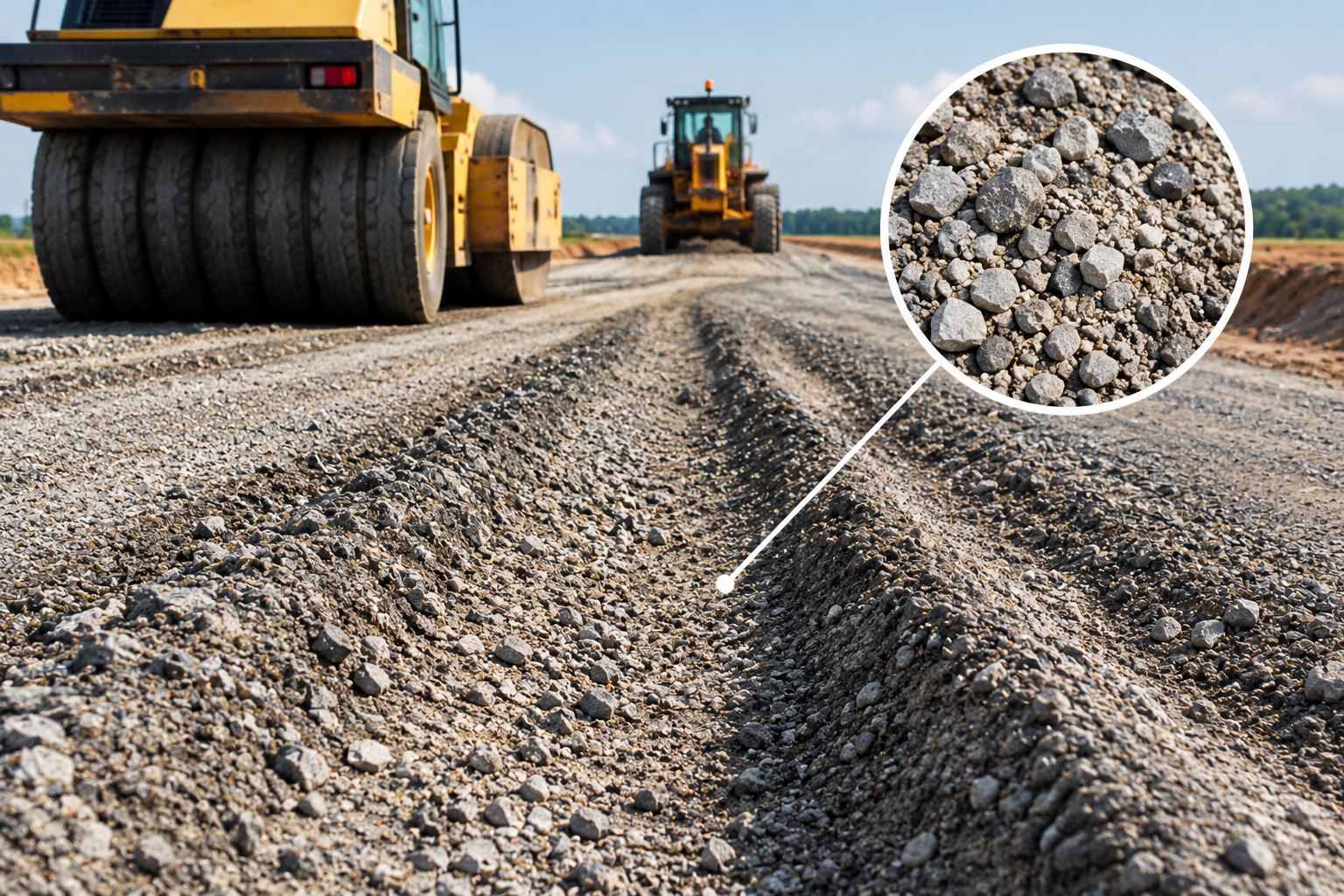
Few job site headaches are more frustrating for a grading contractor than watching a newly spread aggregate course buckle, shove, or groove under the wheels of a water truck or dump transfer. When equipment tires cut deep, permanent wheel tracks into an unpaved platform, work stops dead. Severe road base rutting indicates that the aggregate matrix cannot distribute heavy wheel loads, meaning the structural integrity of the entire pavement section is compromised before paving even starts.
We at Western Materials provide engineering aggregates, crushed rock, and Caltrans base material throughout California. From our many years of serving the grading, civil, and paving communities, we have witnessed firsthand the effects that small nuances of moisture content, subgrade stability, and compaction techniques can play in the success of a stable base and failing lifts.
This blog will address the real-world reasons for the creation of ruts during construction.
Let’s begin:
Understanding Load Transfer in Class 2 Aggregate Layers
To solve rutting, it helps to understand how a quality base carries weight and how compaction affects road base material performance. An aggregate base layer does not act as a solid slab. Instead, it relies on point-to-point friction and the particle interlock that improves road base performance by transferring heavy vertical wheel loads downward through the aggregate layer.
When an axle rolls across an unpaved section, load dispersion reduces the concentrated surface tire pressure (often running between 80 and 100 psi) down to a manageable pressure that the native dirt underneath can support without sinking. If the aggregate particles slip, shear, or roll laterally under tire pressure, this interlock shatters. The material displaces sideways, creating a depression beneath the wheel and pushing up an unstable ridge along the tire shoulder, the classic signature of base course ruttinng.
Primary Triggers of Road Base Rutting on Job Sites
Ruts do not appear without a clear physical cause. During the construction phase, aggregate failures typically trace back to four primary structural issues:
1. Excess Moisture Content and Pore Water Pressure
The presence of water in grading operations is necessary to facilitate movement of the stones such that rollers can compact them into the maximum dry density. In the event moisture increases by just 2 to 3 percent from OMC, then the pores between stones are filled up with free water rather than air.
Water cannot be compressed. When a loaded truck passes on top of the saturated layer of aggregate, the weight of the truck causes the compression of the stone structure, thus increasing pore water pressure in the pores. Due to this hydraulic pressure, the stones will not have any frictional force between them.
2. Subgrade Yielding and Inadequate California Bearing Ratio
In most cases, when you see aggregate failure, it’s because there was failure in the underlying dirt layer. The resistance of the natural subgrade to mechanical penetration is determined by the California Bearing Ratio (CBR) of the subgrade.
When the native clays and silty subgrades are moist, unconsolidated, or have organic materials in them, their CBR value becomes very low. As vehicles drive on top of the base, the loose subgrade sinks like a mattress. No matter how expensive your base stone is, the whole lift will sink into the weak soil. With each pass, the aggregate drives itself vertically into the subgrade, creating surface depressions.
3. Inadequate Base Course Thickness
Each pavement structure is designed for a certain target thickness of base considering the traffic loading and strength of sub-grade. When contractors apply aggregate in very thin layers or when grading operators cut high spots from the surface, it fails to achieve the necessary cross-section to distribute wheel loads.
Thin lifts concentrate tire loads onto a narrow patch of native ground. When the downward pressure exceeds the subgrade's bearing capacity, shear-localized punching occurs, leaving severe ruts along haul routes.
4. Poor Particle Gradation and Rounded Stones
A certified Class 2 aggregate requires a controlled mix of coarse crushed stone, intermediate gravels, and mineral fines, making aggregate gradation important for proper compaction. The coarse stones form a rigid structural skeleton, while angular fines fill the gaps to lock everything into place.
If the material segregates during transport or contains rounded river stones rather than fractured faces, the rocks roll under tires like marbles. Without internal shear resistance, aggregate rutting occurs immediately under heavy rolling stock.
Sourcing Caltrans-Spec Base for Your Next Project?
Contact Us Today
Practical Methods to Prevent Rutting During Construction
Eliminating rutting comes down to disciplined moisture management, verified compaction, and protecting your unpaved layers while earthwork is underway:
1. Conduct Thorough Proof-Rolling Before Spreading Stone: Never lay base over untested dirt. Walk a fully loaded tandem dump truck (minimum 10 to 12 tons on the rear axles) across the prepared subgrade. If you see visible pumping, rutting, or ground deflection over 0.5 inches, stop and stabilize the dirt before trucking in rock.
2. Hit Optimum Moisture Content on the Pad: Do not guess moisture by feeling alone. Test your material on-site using a nuclear gauge or speedy moisture tester. Ensure moisture stays within -1% to +1.5% of the laboratory Proctor target before initiating vibratory compaction passes, while keeping density, gradation, and compaction in balance in the aggregate.
3. Compact in Controlled Lift Thicknesses: Avoid placing loose lifts deeper than 6 to 8 inches at a time. Heavy vibratory smooth-drum rollers lose compactive energy as depth increases, leaving the bottom two inches of deep lifts loose and uncompacted.
4. Use Geotextile Separation Fabrics on Marginal Soils: If you are operating on saturated clays or low CBR soils, put down a heavy geotextile prior to laying the aggregate. This will ensure that your aggregate doesn't punch into the soil and soft mud does not pump up into your aggregate voids.
5. Manage Haul Traffic Routing: Restrict heavy, loaded construction equipment to designated sacrificial haul roads rather than letting drivers take random paths across finished, trimmed base lifts.
Need High-Performance Aggregates Delivered on Schedule?
Call us now
Conclusion
Rutting prevention during construction calls for proper structural design, moisture management, and strict quality control. Whether it results from excessive watering of an aggregate lift, instability and pumping of the subgrade, or insufficient passes for compaction, rutting means that the stone particles cannot lock into place and withstand vertical loads. By proof-rolling the subgrade, managing moisture strictly within the limits of Proctor tolerances, and protecting unpaved lifts from haphazard haul traffic, contractors construct road profiles that easily pass proof and density tests.
Long-term structural performance starts with reliable material sourcing. Western Materials supplies certified, high-friction class 2 road base alongside a full portfolio of crushed rock, gravel, and construction aggregates across California, providing builders and civil contractors with the structural support needed to keep every project moving smoothly.
FAQs
How does controlling moisture content prevent road base rutting?
Balancing moisture ensures lubrication and density. If the aggregates are too dry, they will not slide and interlock since the particles will be loose. Too much moisture in aggregates results in pore pressure that is developed in the rocks due to water trapped between the rocks as they come into contact with the wheels.
What is the minimum California Bearing Ratio needed under the road base?
Engineers usually prefer that the CBR of the subgrade falls within the range of 5% to 10% for normal roads, and higher CBR for highways. If the CBR is lower than 3%, the natural soil becomes too soft to offer resistance against wheel loads and needs chemical treatment or geotextiles in the subgrade.
Can running a heavier roller fix a rutting aggregate base?
Not always. If rutting is caused by an over-saturated base or a spongy subgrade, bringing in a heavier roller will worsen the issue. The extra weight pushes water into closed voids and breaks aggregate particles, accelerating shear failure instead of achieving proper compaction.
What causes a clean aggregate base to segregate during placement?
Segregation occurs when material is dumped in high, conical piles, causing coarse stone to roll down the outer edges while fines collect in the center. Spreading segregated piles leaves pockets of coarse rock without binding fines, resulting in weak zones that rut instantly under haul traffic.
How do you repair an aggregate section that has already rutted?
Surface grading will not solve the underlying problem. The rutted zone must be scarified to the full depth of the compromised lift, checked for trapped moisture, and blended uniformly. If the subgrade below has yielded, excavate the area, re-compact the native dirt, and reinstall the aggregate to full specification.
.avif)
Materials management and founders
have produced and supplied high quality
sand and gravel to contractors &
aggregate users across California.
.svg)
.svg)


