.png)

How Does Sand Moisture Affect Material Quantity and Performance?
Published on:
September 7, 2026
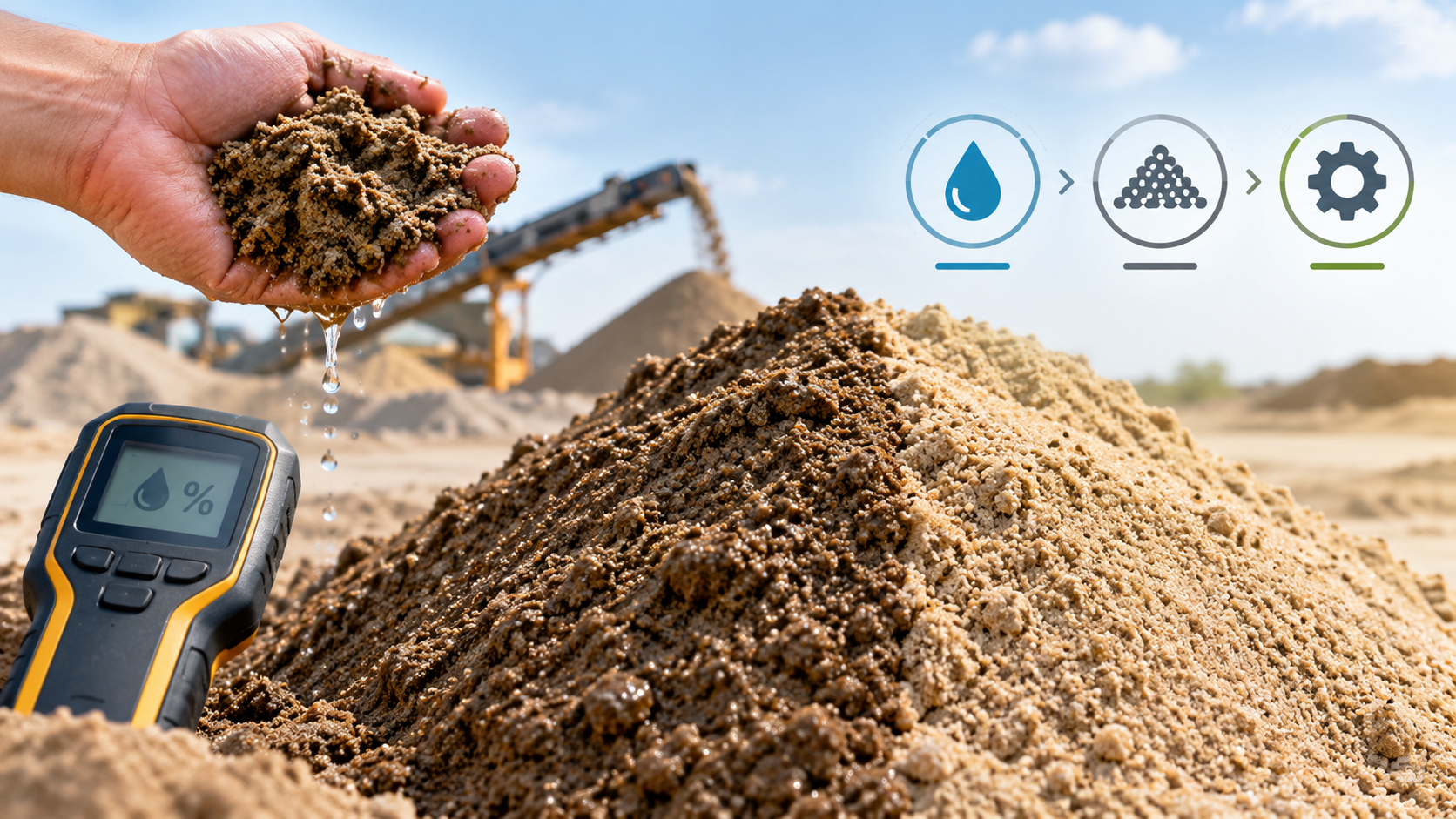
Every seasoned builder knows that raw aggregate changes the moment water touches it. In an active construction site, it is uncommon for sand to be dry. Moisture from rain, humidity, and outside pile storage contributes to a change in the total volume and weight of the sand, as well as its mechanics. For those involved with the construction industry working with Western Materials, knowing the moisture content in construction grade sand is crucial to keeping costs down.
In this comprehensive guide, we examine how fluctuating water ratios distort material estimates, why volume measurements can mislead field crews, and how moisture shifts structural performance in concrete, masonry, and bedding applications. You will learn the mechanics behind aggregate bulking, how to calculate sand and gravel quantities for large projects, how to accurately calculate dry mass versus water mass, and the field practices needed to keep structural installations on spec from dispatch to final pour.
Why Sand Moisture Level Alters Bulk Material Calculations
When you order loose aggregate by the ton or by the cubic yard, the presence of water creates an immediate challenge: you are often paying for water weight or being deceived by expanded volume.
A shifting sand moisture level directly skews haul weights and delivery volumes. If sand sits out in humid weather or after a storm, water coats each grain. The water is only an excess weight that cannot be used as part of the aggregate. If a load of 20 tons contains 7% of water, the quantity of water would be around 1.4 tons without having any mineral content. In case you are unaware of this disparity, you will have less aggregate production and hence your loads will be short.
The Physics of Bulking: How Wet Sand Quantity Tricks the Eye
Many people assume adding water to dry sand makes it denser and more compact. In reality, the exact opposite happens up to a specific threshold. This physical phenomenon is known as bulking.
When a fine aggregate takes in a small to mid amount of water, usually about 4% to 8%, a thin water layer forms on each mineral grain, and the fineness modulus can help explain how the particle size distribution of construction sand affects its behavior. The surface tension of that water helps hold the film in place. Because of the film, nearby sand grains do not sit as close to each other. They end up spaced farther apart, so the bulk material swells. It takes up much more volume than it would when fully dry, or when fully underwater.
If the sand grows in volume, any wet or uncalibrated way of measuring it can make you think the hopper has more than it really does, sometimes by about 25% to 30%. After that thick sand is combined with cement and more water, the surface tension fails. The air pockets shrink, and the total volume falls fast. Then, if the team counts batches by shovel or use simple volumetric hoppers and do not adjust for the bulking, the mix can come out short on aggregate. That throws off the ratios and pushes project costs higher.
Measuring Water Ratios: Volumetric Measurement vs Gravimetric Moisture Content
Managing job site aggregates requires moving away from guesswork and adopting reliable testing procedures. The industry relies on two primary approaches to track water within aggregates:
Volumetric Measurement
Volumetric measurements in the field calculate the physical volume occupied by the dampened aggregate in relation to the dry and saturated form of the material. In the field process, workers usually apply calibrated boxes in order to assess the reduction in volume caused by filling the volume of loose damp sand with water. Although useful for immediate field tests on a regular basis, volume checks may not always be accurate because of different conditions of loose density.
Gravimetric Moisture Content
For structural specifications and precision batch plants, gravimetric moisture content serves as the definitive engineering standard. This laboratory-proven method measures mass rather than bulk volume:
- A representative field sample is weighed in its damp condition ($W_{wet}$).
- The sample is dried completely in a field oven, hot plate, or microwave until reaching a stable, constant weight ($W_{dry}$).
- The moisture percentage is calculated using the standard formula:
$$\text{Moisture Content (\%)} = \frac{W_{wet} - W_{dry}}{W_{dry}} \times 100$$
By isolating true dry weight from free water weight, batch managers can accurately adjust their scale settings. This ensures the correct dry mineral mass enters the mixer regardless of how wet the stockpile is that morning.
How Unchecked Moisture Degrades Concrete and Mortar Performance
Water plays an important role in the hydration reaction process of Portland cement, although too much water will weaken the structural mixture. If water enters the drum through sand, two primary issues arise:
Water-Cement Ratio Disruption
The water-cement ($w/c$) ratio determines the compressive strength, density, and durability of hardened concrete. Mix designs calculate water requirements down to the gallon, which is why aggregate absorption can have an important effect on concrete mix design. If aggregate carries 5% unaccounted surface moisture, several gallons of surplus water enter the mix unnoticed. This surplus raises the $w/c$ ratio, diluting the cement paste. The result is lower compressive strength, elevated shrinkage cracking, increased porosity, and reduced resistance to weathering and freeze-thaw cycles.
Workability, Slump, and Segregation
An excess of water in a well-hidden form will result in a low-slump concrete mix becoming high-slump concrete. Although the latter is easier to pour and rake, high-slump concrete mixed with excessive amounts of water will suffer from bleeding channels and segregation. The heavy gravel content of concrete will sink to the bottom, and the light cement and sand slurry mixture will rise to the top.
Get reliable, construction‑grade sand tested for moisture consistency.
Order Quality Sand Today
Source Certified Aggregate for Dependable Project Outcomes
Water variation control begins by selecting properly cleaned, graded, and consistently supplied materials. At Western Materials, we offer high-performance sand and aggregate solutions that have been properly tested for high yields and meet strict requirements for municipal, commercial, and residential construction projects. Partnering with us as your aggregate provider means you will get full control of your batch process and ensure the structural integrity of your projects.
Frequently Asked Questions
What is sand moisture content and why is it important?
Sand moisture content means the water in the sand as a share of the sand’s dry mass. This matters a lot. When the sand has more or less water, the batch weight can shift. The extra water also makes the sand take up more space, which is called bulking. Moisture can also change the water-to-cement ratio in the mix. That ratio then affects how strong and how long-lasting the finished concrete is after it cures.
How does surface moisture cause sand to expand in volume?
A light layer of water can sit on each sand grain. Because of surface tension, the grains keep a bit of distance. That spacing leaves extra space, so the grains do not pack as tightly. This effect is often called bulking. In some cases, the sand takes up as much as about 30% more space than you would expect from the dry amount, so it can look like there is more sand than there really is.
How does wet sand affect concrete mix water calculations?
The wet sand will contain free water on the outside surface of its particles to enter into the mixing drum. Unless the amount of water contained by the wet sand is accounted for and deducted from the mix design, the resulting water-cement ratio will be higher than intended.
What is the quickest way to test aggregate moisture in the field?
A quick way to get solid results is the rapid dry-out test. Use a portable hot plate, a field stove, or an aggregate microwave unit. First, teams weigh the wet sample. Then they heat it until no steam comes off and the weight stops changing. After that, they weigh it again. The difference lets them figure out the exact share of water that was lost.
Can sand moisture level affect compaction in pipe bedding or pavers?
Yes, because compaction relies on attaining an ideal moisture level range, which also plays an important role in how compaction affects road base material performance. If the sand is dry, it will not compact efficiently, whereas excess saturation will create pore water pressure that resists the process of compaction. An appropriate level of moisture makes the grains slippery and helps them lock into place when mechanically tamped down.
.avif)
Materials management and founders
have produced and supplied high quality
sand and gravel to contractors &
aggregate users across California.
.svg)
.svg)


