.png)

How Does Rock Weight Affect Rip Rap Resistance to Displacement?
Published on:
September 30, 2026
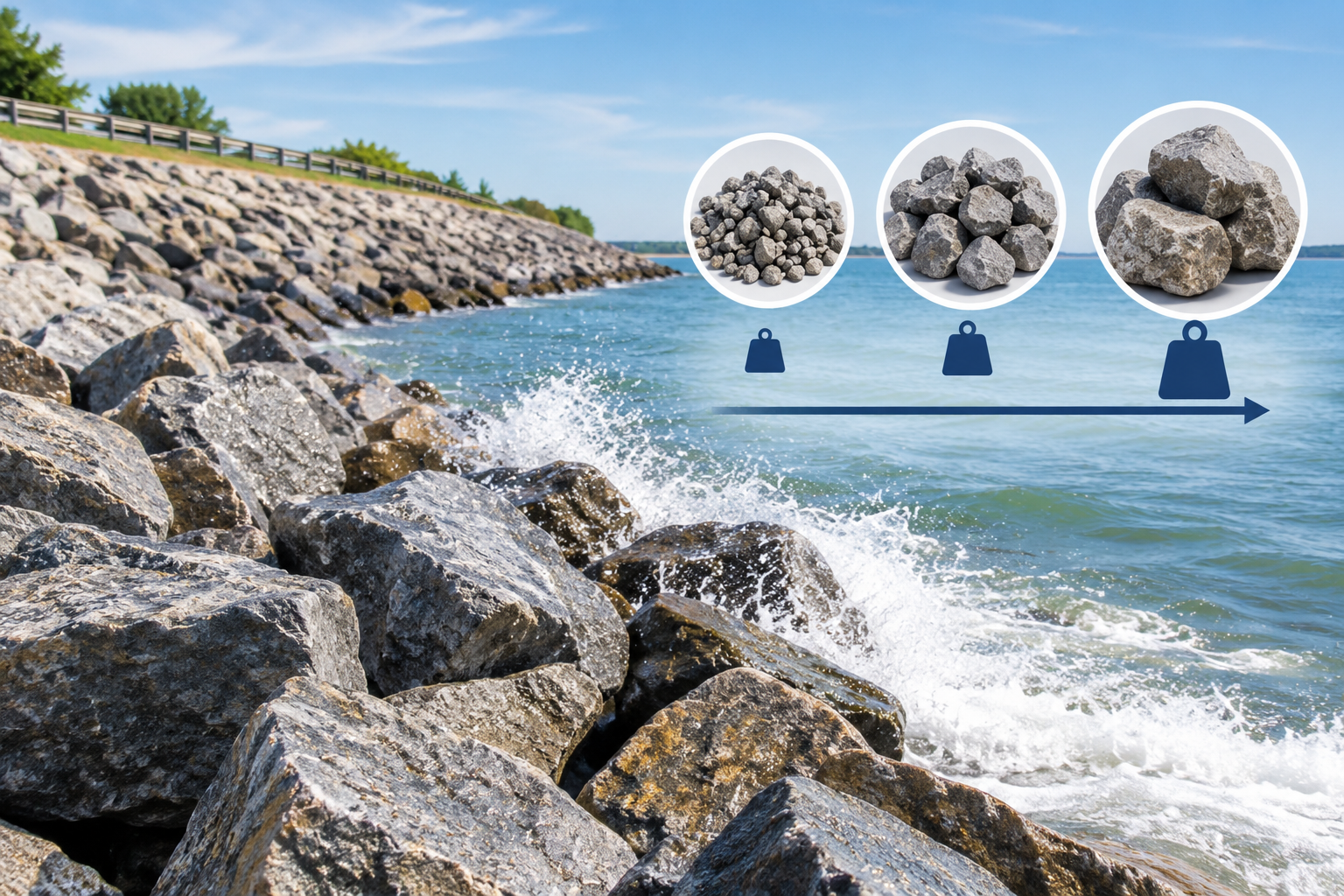
Controlling hydraulic erosion along culverts, riverbanks, drainage ditches, and retention basins comes down to a fundamental physical battle: the destructive power of moving water versus the resting inertia of stone. While factors like slope angle and filter fabric play a role, stone mass is the primary variable that prevents armor stone from washing downstream during severe flood stages. Achieving long-term rip rap rocks stability depends directly on calculating whether an individual stone has enough submerged gravitational weight to counter fluid lift and dragging forces.
At Western Materials, we supply heavy construction aggregates, cobbles, and erosion control stone. We regularly help civil engineers, public works contractors, and land developers choose aggregate gradations that stay anchored under peak hydraulic discharge.
In this article, we break down the physics behind stone displacement: how submerged density counteracts tractive force, how hydraulic shear stress dislodges undersized materials, why weight distribution across a graduated sieve profile matters, and how to size your stone to build an armor layer that will not shift or fail.
The Physics of Water Velocity, Lift, and Stone Mass
When open-channel runoff speeds over an unarmored embankment, fluid friction creates boundary drag along the channel bed. As water velocity climbs, this boundary layer turns turbulent, creating localized pressure drops across the tops of stones while high static pressure builds underneath them. This pressure imbalance generates hydrodynamic lift; the same mechanism that lifts an airplane wing.
A stone rests securely on an embankment only when its submerged gravitational mass exceeds the combined sum of fluid lift and drag:
- Submerged Weight ($W_s$): Water buoys stone upward, reducing its effective mass by roughly 35% to 40% depending on mineral density. A rock must have high enough dry mass so that its remaining underwater weight creates sufficient friction against adjacent stones.
- Hydrodynamic Lift ($F_L$): Upward suction created by localized velocity gradients across the rock's crown.
- Hydrostatic Drag / Tractive Force ($F_D$): The lateral pushing force exerted parallel to the channel bed by high-velocity currents.
If a stone's weight is too low, fluid lift breaks its point-to-point contact with neighboring stones. Once a rock loses contact with the revetment bed, drag rolls or sweeps it downstream instantly, leaving a gap in the armor layer.
Why Individual Rock Weight Overcomes Hydraulic Shear Stress
Engineers use hydraulic shear stress (the frictional drag exerted by moving water over a specific surface area of channel perimeter) to calculate whether an earthen or stone slope will hold. As flow volume and channel gradient rise, boundary shear stress increases, making hydraulic velocity an important factor in rip rap selection.
Stone mass resists this stress through resting inertia. Heavier stones resist sliding because their downward force drives friction deep into the bedding layer beneath. Angular, heavy stones nest together tightly, transferring forces between adjacent rocks rather than forcing a single stone to bear the full brunt of the current.
However, weight must be evaluated underwater. A heavy porous rock can be huge, but its specific gravity would be very low once it is submerged. It is only heavy rock such as granite, basalt, or dense limestone, having a specific gravity of 2.55 – 2.65 or higher, that provides enough ballast weight to endure the flow.
Need a Heavy-Duty Erosion Control Stone for Your Project?
Request an Erosion Control Stone Quote
How Tractive Force Causes Rock Displacement
The primary mechanism behind bank washouts is rock displacement driven by excessive tractive force, which is one reason rip rap is commonly used around bridges and other infrastructure. This force acts tangentially along the wetted perimeter of the channel, pushing parallel to the direction of flow.
Displacement usually happens through one of three physical modes:
1. Rotational Plucking and Rolling
When water flows past a stone that sticks out higher than the surrounding matrix, tractive drag catches its exposed edge. If the stone lacks sufficient downward weight, the hydraulic moment overcomes the stone's resting pivot point, tipping it forward and rolling it out of its pocket.
2. Edge Sliding Along Steep Embankments
On steep channel side slopes (such as 2:1 or 1.5:1 grades), gravity pulls downward across the angle of the slope. If individual stones are too light, tractive force easily overcomes the natural angle of repose, sliding the stones down to the toe of the slope and exposing the bare embankment above.
3. Progressive Unraveling
Rip rap functions as an interconnected system. The moment one undersized rock is lifted and carried away, surrounding stones lose their lateral support. Water surges into the resulting depression, increasing turbulence and quickly pulling out neighboring stones one by one until the entire revetment unravels.
Field Practices to Maximize Armor Layer Performance
Proper installation is just as critical as sourcing the right stone weight. To ensure your revetment stays anchored during peak runoff events:
- Place Stone with Equipment, Never Dump: Dropping large rock from an excavator bucket down a slope segregates the material, sending heavy rocks to the bottom while light spalls remain at the top. Place stone methodically to maintain an even, interlocked matrix.
- Layer Thickness Must Match Maximum Size: The total thickness of your stone revetment should equal at least 1.5 to 2 times the median stone diameter ($D_{50}$), or no less than the diameter of the largest stone ($D_{100}$). Stone size plays an important role in erosion control, so the total thickness of your stone revetment should match the size of the material being installed.
- Always Anchor the Toe: High water velocities scour channel bottoms first. Dig a deep toe trench at the base of your slope and fill it with your heaviest rock to prevent the entire slope from sliding downward.
- Install Engineered Separation Fabric: Even the heaviest stone layer will fail if water sucks fine soil through the rock voids. Lay a durable non-woven geotextile fabric beneath the stone to allow drainage while keeping base soils locked in place.
Conclusion
In order to protect your channel banks, culverts, and bridge abutments from hydraulic scour, it is essential to work with the natural force, rather than resist it. During high flow rates during floods, water develops considerable lifting power and frictional force that would tend to detach the smaller and lighter stones. Choosing the proper submerged density, angularity, and stone size ensures interlocking of your armor stones.
For contractors and civil engineers across California, selecting the correct stone mix is essential to building installations that withstand major storm events. Western Materials supplies high-density, durable rip rap rock and heavy aggregate materials tailored to your project's exact slope, flow velocity, and engineering specifications.
FAQs
How does stone weight ensure long-term rip rap stability?
Sufficient stone mass provides the submerged gravitational ballast needed to keep rocks resting on channel slopes. This downward force generates friction between adjacent stones, enabling the revetment layer to resist hydrodynamic lift, sliding, and rolling caused by fast-moving floodwaters and intense channel discharge.
What is the relationship between water velocity and required rock weight?
Water's dragging force increases with the square of its velocity. Doubling flow velocity quadruples boundary shear forces across the channel bed. Consequently, higher water speeds demand much heavier, angular stones to provide enough mass to keep the armor layer from shifting.
Why is specific gravity more critical than dry rock weight?
This is because the buoyant force of the water pushes the stone up, and therefore a stone loses weight that is equivalent to the weight of water displaced by its volume. Stones with high specific gravity are dense and will be heavy in water.
What happens when rip rap lacks proper size variation?
Uniformly sized stone leaves wide open voids across the revetment. High-velocity currents sweep into these openings, creating turbulent eddies that wash away the bedding soil underneath. A well-graded mix packs tightly, using smaller stones to wedge larger ones firmly into place.
How does an anchored toe trench prevent slope failure?
Water can wash away the bottom of the channels very rapidly and destroy the base of support for the embankment. Placing heavy stone in a deep trench at the toe ties down the whole construction from beneath so that the upper slope cannot push the revetment down.
.avif)
Materials management and founders
have produced and supplied high quality
sand and gravel to contractors &
aggregate users across California.
.svg)
.svg)


