.png)

How Does Repeated Harrowing Affect Arena Sand Gradation?
Published on:
September 30, 2026
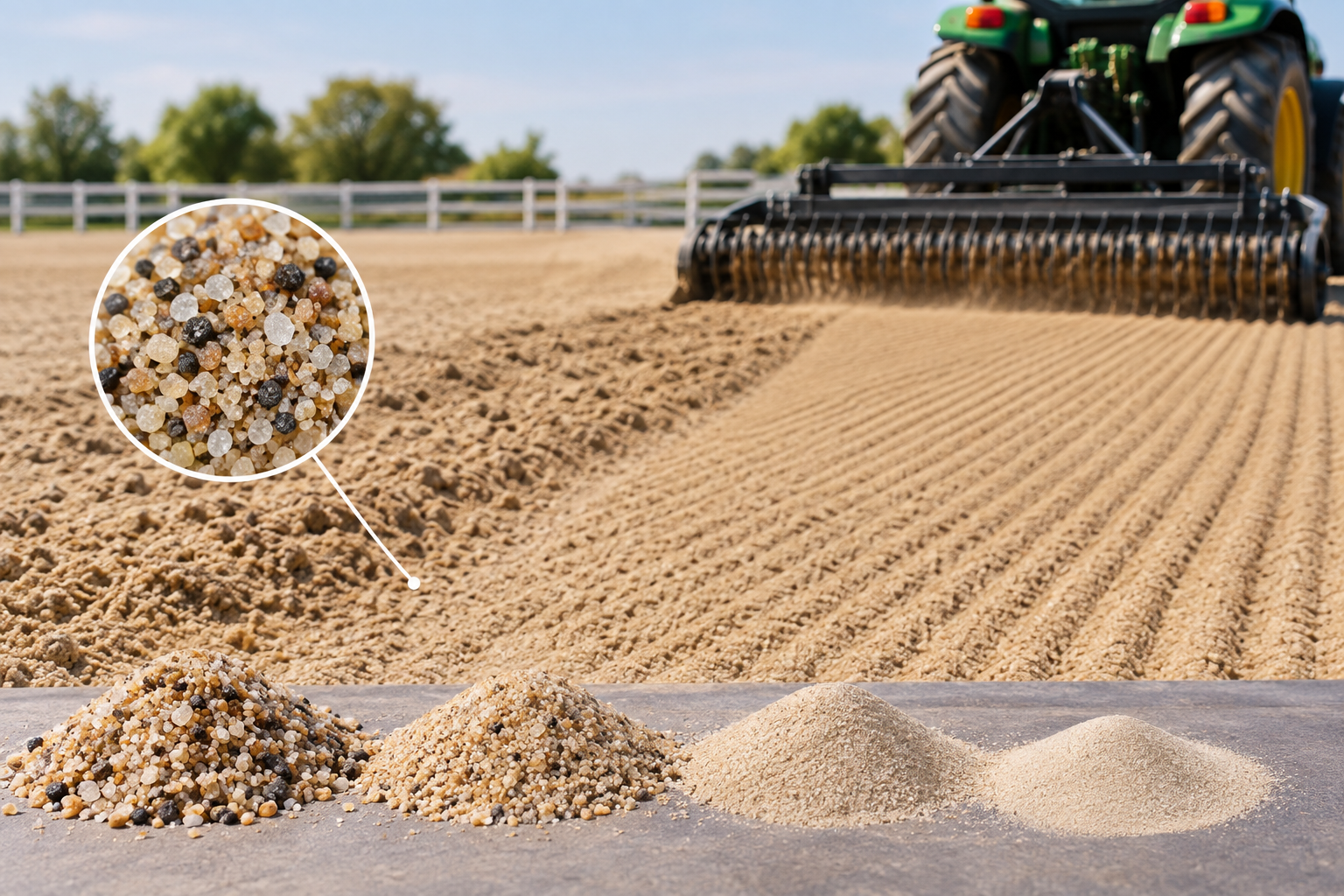
Every equestrian facility manager knows the rhythm of arena care: drag the track, level the grade, smooth out the ruts, and repeat. But while dragging produces an inviting, uniform surface on top, the mechanical forces at play underneath tell a different story. Routine arena sand maintenance involves heavy drags, rolling tines, and regular mechanical friction. Over months and years of use, these repeated physical interactions fundamentally alter your sand's sieve profile, mineral integrity, and structural behavior.
Western Materials provides engineered aggregate mixtures throughout California, and we witness firsthand the effects that dragging can have on horse surfaces. When choosing sand for horse arena applications, understanding how routine grooming affects the material is essential for maintaining a consistent and flexible surface. This guide is designed to discuss the mechanics of mechanical grooming in relation to the breakdown of particle size, material segregation, the risks of dragging at an incorrect depth, and what measures can be taken to ensure a flexible surface.
What Is Arena Sand Gradation and Why Does It Matter?
Before analyzing the effects that a drag has on the agglomeration of footing materials, it is necessary to know what makes the best horse arena footing for an equestrian surface. Footing gradation means the particular ratio of sand grain sizes in the composition of the arena profile—from coarse grains to medium, fine sand, and micro-fines.
When you install Arena footing sand, you are balancing two conflicting physical needs:
1. Traction: The surface should provide enough traction for the horse to be able to push off, turn, or land without slipping.
2. Shock Absorption: The surface should have a certain level of give or cushioning to provide protection for the fragile joints, tendons, and ligaments of the horse.
A properly graded sand has subangular particles in several sizes of sieves, which can also affect your horse's hoof health and overall comfort on the surface. Large-sized particles form an open matrix that allows draining of excess moisture and carrying of weight, while medium- and fine-sized particles fill up the voids to give stability when there is hoof pressure.
The Mechanical Impact of Repeated Dragging on Sand Grains
Harrowing does not simply fluff the surface; it subjects sand particles to abrasive shear, pressure, and kinetic friction. Over time, dragging equipment alters aggregate mechanics in several distinct ways:
1. Particle Attrition and Grain Breakdown
Grains of sand are not everlasting. With every pass of the metal tines turning the ground, they rub up against one another and against the equipment. Through thousands of such passes, softer components like calcium carbonate and feldspar break down into smaller parts. Even tough, high quartz sands experience attrition along their jagged edges.
As angular edges round off and grains shatter, the overall gradation migrates toward smaller sieve sizes. Sand that started out coarse and free-draining gradually accumulates high concentrations of silt-like micro-particles.
2. Vertical Sifting and Layer Segregation
The process where mixed particles segregate themselves due to mechanical action is referred to as granular segregation or "the Brazil nut effect." As the harrow moves across the sand, large particles tend to move upwards while small heavy particles move downwards.
3. Destruction of Particle Angularity
Initial traction in an arena depends on particle shape. Sub-angular grains lock together under downward hoof pressure, forming a firm platform. Repeated harrowing rolls these grains repeatedly, polishing their edges. Once grains become spherical, they act like tiny ball bearings. The footing loses stability, causing horses to work harder and increasing the risk of soft-tissue fatigue.
Need Help Choosing the Right Aggregate for Your Track?
Request an Arena Sand Quote
How Harrowing Depth and Equipment Selection Influence Gradation
Not all grooming creates the same rate of wear. The speed, frequency, and specific depth settings of your equipment dictate how fast your aggregate changes.
Regulating Harrowing Depth
Proper harrowing depth should generally match your discipline’s target cushion depth, typically 2 to 3 inches for most flat work and jumping. Setting tines too deep creates a severe hazard: tines can strike the compacted road base or stone dust layer beneath the sand.
When a harrow gouges the base, it pulls fractured road base rocks, heavy clay, and coarse gravel straight up into the clean sand. This permanently ruins the footing gradation, creates dangerous tripping hazards, and destroys the arena's drainage grade.
The Role of Aeration in Compaction Control
Grooming provides essential aeration, breaking the surface crust caused by watering and hoof traffic. Without routine mechanical aeration, wet fines bind together and create concrete-like compaction.
However, over-harrowing, such as dragging multiple times a day when only light maintenance is needed, accelerates grain degradation and can contribute to uneven footing in horse arenas. The key is dragging with adequate moisture and matching tine depth to the specific density of your footing, especially when weather impacts horse arena sand throughout the year.
Conclusion
Managing an arena surface entails balancing proper grooming and aggregate protection. Dragging is essential to ensure a uniform and cushioning track; however, the constant mechanical friction will inevitably alter your aggregate properties by way of attrition, abrasion, and vertical stratification. Proper control of your dragging depth, proper moisture levels, and regular evaluation of your surface will help in protecting your base and your horse athletes.
In case maintenance will no longer suffice for addressing severe compacting and excessive fines, the most practical thing you could do would be to improve your surface through high-quality aggregates. Western Materials provides top-notch washed horse arena sand for your surfaces all throughout California.
FAQs
How does proper arena sand maintenance prevent footing deterioration?
The practice of maintaining arena sand ensures proper moisture content in the arena, avoids the formation of hard pan crust and distributes the sand that moves to the arena walls. Proper grooming at appropriate depth with proper moisture reduces friction wear, thus avoiding premature breakdown of the grains into dust.
What causes sand to break down into dust over time?
Disintegration occurs mechanically. With every hoof beat or harrowing, the grains rub against each other. Softer components such as limestone disintegrate faster, but quartz is less prone to disintegration because it is more resistant to wear. Lack of sufficient moisture means that there is nothing to act as a lubricating barrier between the particles.
How deep should you set arena drag tines during maintenance?
Drag tines should generally penetrate between 1.5 to 2.5 inches, depending on the discipline and the depth of your horse arena footing. The tines should never penetrate the full depth of your sand layer. Maintaining a safe buffer zone above the arena sub-base prevents equipment from tearing into compacted stone base materials and contaminating clean footing sand.
Can broken-down arena sand be restored without full replacement?
Yes, in many cases. If there is minimal contamination, then aging sand can be refreshed through adding sub-angular aggregate to reestablish structural voids or incorporating geotextile fibers. But, in situations where the problem has resulted in drainage failure due to too much silt being present, replacement may be a better economic choice.
Why does harrowing dry arena footing cause faster damage?
Grooming dry footing eliminates the thin water film that lubricates individual sand grains during movement. Without moisture, direct mineral-on-mineral friction spikes dramatically. This accelerates grain fracture, creates airborne silica dust, and causes immediate segregation, leaving large grains loose on top while powdered fines sift directly to the base.
.avif)
Materials management and founders
have produced and supplied high quality
sand and gravel to contractors &
aggregate users across California.
.svg)
.svg)


