.png)

How Does Particle Interlock Improve Road Base Performance?
Published on:
August 28, 2026
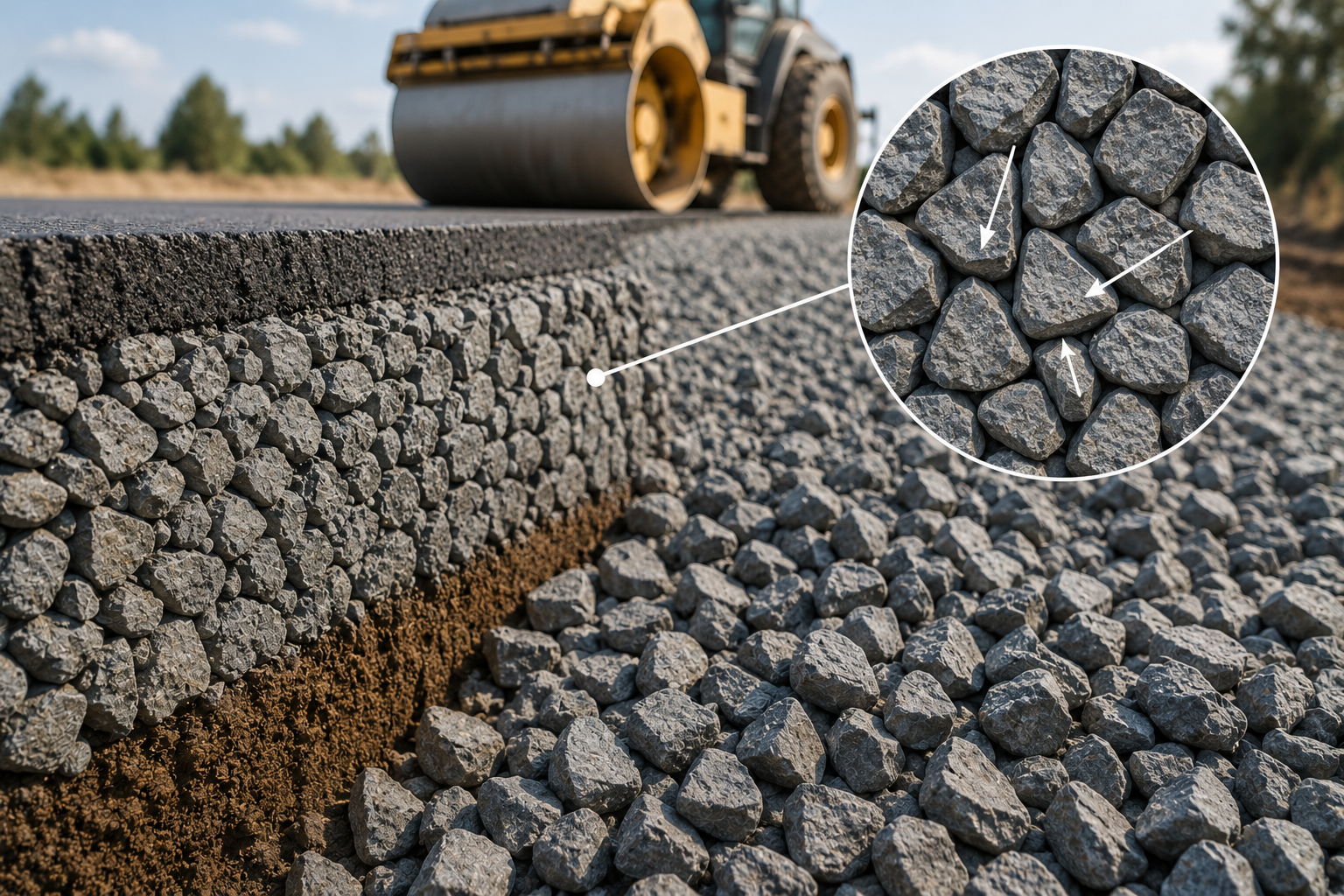
Most roads fail from the ground up. The surface looks fine until the base underneath starts to shift, and then cracks and potholes show fast.
Particle interlock is the difference between a weak foundation and one that holds heavy loads for decades. It’s the grip between crushed stones that spreads weight and resists movement.
Without strong interlock, a road base is just loose rock. With it, you get stability, strength, and a foundation that lasts.
What Is Aggregate Interlock?
Aggregate Interlock happens when crushed stone pieces wedge together under compaction. Sharp, angular edges grab each other instead of sliding past. Think of a dry stone wall; each rock locks into the ones around it.
That locking isn't a chemical bond. No glue involved. It's pure mechanical friction between rough surfaces, exactly what keeps heavy loads from punching through.
Why Load Distribution Depends on the Base Layer
This is where interlock earns its keep. When a truck wheel hits the surface, the force doesn't stop at the top. Interlocked particles spread that energy sideways and downward across a wide area of soil, improving load distribution and reducing concentrated stress
That spread keeps any single spot from taking the whole hit. Weak bases concentrate stress in one place, causing ruts, cracks, and potholes too early.
Think about standing on one foot in soft sand. You sink. Now lie down on that same sand, and you float. Interlock does the same thing for your road: it turns a point load into a distributed one.
Aggregate Gradation: The Secret to a Dense Base
It controls how well particles lock. You want a mix of big and small stones. Small pieces fill the voids between large ones, creating more contact points and improving aggregate gradation.
The other half is how tightly the roller packs those particles. A vibratory roller settles stones into their tightest arrangement. A loose base means particles shift. A dense base means they're stuck; that's where real strength comes from.
Without proper compaction, particle interlock never really develops. You just have a pile of rocks pretending to be a road base.
Shear Strength and CBR: The Numbers Behind a Solid Road Foundation
California Bearing Ratio (CBR) tells you how well your base supports heavy loads compared to a standard crushed rock sample, making the CBR of sand vs gravel subgrades an important consideration. Engineers trust it most when designing pavement thickness.
A high CBR means the base can handle traffic without deforming. Interlocked particles push that number up by resisting sliding and holding their shape.
Road Base Aggregate: Choosing the Right Base Course Material
It should always be crushed, not rounded, because angular and rounded gravel behave differently when subjected to load. Crushed stone has rough surfaces that create particle locking. That mechanical grip separates good base from mediocre base.
It also needs the right amount of fines, the dusty stuff. Too few and the layer stays loose. Too many and water can't drain. A well-graded mix hits the sweet spot.
How to Spot Good Interlock on Site
Here's how to check interlock without fancy equipment:
- The surface doesn't shift under your boots or a loaded wheel. If it moves at all, particles are sliding instead of locking, and ruts will show up fast.
- Raking the top layer takes real effort. A loose, easy-raking base means the stones never found their grip. A properly locked base fights back against every tool.
- A test hole shows clean, tight layers instead of loose pockets. You should see uniform stone from top to bottom, with no segregated clumps or soft zones.
- Water runs off the surface instead of soaking straight through. A locked base sheds water quickly, while a loose one drinks it up and starts to soften.
- The base holds a firm edge when you cut it vertically. Soft edges that crumble under your boot are a sure sign of weak interlock in the layer.
Particle Interlock: Jobsite Mistakes That Kill It
Even with great material, a few mistakes can wreck interlock before the roller shows up. Here's what ruins more bases than anything:
- Dumping gravel onto soft dirt without clearing and leveling the ground first can lead to movement, which is why proper stone and gravel layering matters. The subgrade has to be firm and even, or nothing above it will ever lock properly.
- Spreading the base too thick and hoping one roller pass fixes it can reduce road base material performance, since proper compaction requires the material to be placed in suitable lifts.
- Using rounded, uncrushed rock because it was less expensive. Round stones roll past each other. They don't lock, no matter how many passes the roller makes.
- Skipping water during compaction. A little moisture helps the fines bind particles together. Dry stone just shifts around, no matter how hard you work it.
- Driving on the loose base before it's compacted. Vehicle traffic separates the material and creates soft spots that undo hours of careful spreading.
Choosing a Road Base Material Supplier
Whatever you choose, insist on clean, crushed, well-graded stone from a supplier who tests their stock. A great price usually costs more in the end; you'll rework it within a season.
At Western Materials, we deliver crushed rock across California. From Los Angeles to Sacramento, our stone is tested, properly graded, and ready to compact. Call (888) 944-9994 for a quote.
We've supplied contractors, landscapers, and homeowners for years. A few tons or a few thousand, we'll get you the right material.
Conclusion
The base layer is the quiet workhorse of every road. It takes the punishment you never see: heavy loads, weather, years of traffic. And it keeps the surface above it smooth and solid.
None of that happens by accident. It starts with the right road base material: crushed, well-graded stone that locks together under compaction. It takes thin lifts, the right moisture, and a roller that actually does its job.
Get those steps right, and the base pays you back for decades. Get them wrong, and you'll be tearing it up and paying twice within a season.
So before you spread a single load of rock, ask yourself one question: is this material actually going to lock? The stones will tell you. Listen.
FAQ
What does compaction actually do to the base?
Compaction density is how tightly crushed stones are packed together. It matters because loose packing lets particles slide under load. At Western Materials, we supply base material graded to compact into a dense, stable layer, so your compaction effort actually pays off.
How thick should a road base layer be?
For most driveways, four to six inches of compacted base works well. Heavier traffic, like truck yards or commercial lots, needs eight to twelve inches. Soil conditions and load matter too, so have an engineer check before you order material.
Can I reuse old concrete as road base?
Yes, recycled concrete works as road base if it's crushed to the right gradation. The particles need sharp edges and the right fines content. Poorly crushed recycled material won't interlock well, so always ask your supplier for test results before you buy.
Why does my base keep shifting even after compaction?
Shifting usually means one of three problems: rounded aggregate, too little fines, or too much moisture. Check the material's gradation first, then confirm you compacted in thin lifts. Sometimes re-grading with fresh crushed rock is the fastest fix on the job.
Do I really need geotextile fabric under the base?
In most cases, yes. Every season, fabric stops fine subgrade soil from pumping up into the base, which ruins interlock over time. It's a small cost compared to redoing the whole road down the line, especially on soft or wet ground.
.avif)
Materials management and founders
have produced and supplied high quality
sand and gravel to contractors &
aggregate users across California.
.svg)
.svg)


