.png)

How Does Particle Angularity Affect Volleyball Court Footing?
Published on:
September 24, 2026
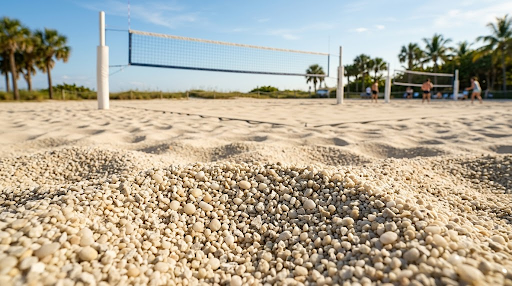
Anyone who has played competitive beach volleyball knows that sinking feeling when your feet give way during a jump approach. One second you are planting your feet to drive upward for a spike, and the next, the ground blows out from underneath your toes. Most people assume the depth of the pit is to blame, but the real culprit comes down to grain geometry.
In sports aggregate design, particle angularity is the single most influential physical factor determining whether an athletic surface supports quick directional cuts or turns into an unstable, injury-prone pit.
At Western Materials, we source and supply specialized sports aggregates, washed masonry sands, and bulk construction materials. We see firsthand how subtle grain variations change surface behavior underfoot.
In this guide, we break down what grain geometry really means, how it governs internal friction and sand displacement, why player biomechanics depend on it, and how to source the right aggregate balance for a durable, high-performance court.
What Is Particle Angularity in Sports Sand?
When you look at bulk sand from across a court, it looks like a uniform golden carpet. Put a scoop of that same material under a magnifying lens, though, and you will see an entirely different landscape. Every individual grain has a distinct three-dimensional shape, classified geologically along a scale ranging from very angular to well-rounded.
Angular particles feature sharp corners, defined edges, and uneven planes created by mechanical crushing or recent geological fracturing. Sub-angular grains have slightly softened edges, while rounded grains have spent thousands of years tumbling in rivers, oceans, or wind-blown dunes, grinding away any sharp projections until they resemble tiny smooth marbles.
In beach volleyball, grain shape directly controls how particles interact when external pressure is applied. Rounded grains roll past one another more easily, while angular materials tend to resist movement, making the difference between angular and rounded materials important when evaluating court footing. Angular grains, on the other hand, feature interlocking contact points that resist movement. Striking the right balance within this spectrum is the secret to building an athletic court that feels predictable under bare feet.
The Physics of Interparticle Friction and Sand Displacement
When an athlete sprints across a sand court, their foot delivers two distinct forces: a downward vertical load and a backward horizontal shear force. How the court responds to that shear force depends almost entirely on internal shear resistance, a property known in geotechnical engineering as interparticle friction.
When sand grains are excessively rounded, the shear force causes the particles to slide and spin freely across one another. This produces massive sand displacement, commonly called "blowout." Repeated displacement can move sand away from high-use areas, which can eventually cause a volleyball court to develop low spots and uneven footing.
Conversely, when grains possess mild angularity, the irregular edges lock into adjacent facets. This microscopic interlocking generates high interparticle friction, giving the athlete a stable, firm platform to push off from. However, there is a clear upper limit. If the aggregate is excessively sharp or crushed, the particles interlock too tightly, packing down like concrete after rainfall and stripping away the shock absorption that protects joints during hard landings.
Planning a Court Build or Surface Refresh?
Request Sand Spec Sheet & Quote
Impact on Player Biomechanics and Injury Prevention
Court footing directly dictates how an athlete's muscles and joints absorb stress. Playing on sand naturally challenges stabilizing muscles in the ankles and knees, but extreme grain shapes tilt that challenge into hazardous territory.
When a court suffers from excessive displacement due to rounded sand, players face severe soft-tissue fatigue. The Achilles tendon and the calf muscles have to exert twice as much effort to maintain balance while standing on the unstable surface. With fatigue building up with longer repetitions, athletes are losing control over their landing technique and become highly vulnerable to ankle inversions and sprain injuries.
On the contrary, too many sharp grains result in significant abrasion of the surface. The sport requires volleyball players to dive, slide, and scrape their knees on the court constantly, which is why understanding the risks of using improper sand on a volleyball court matters when selecting the surface material. Excessively sharp particles serve like sandpaper to the exposed skin, resulting in friction burns which take a lot of time to heal. The perfect playing field should include sub-angular or sub-rounded grains, providing enough grip between particles for lateral movements and not cutting the skin nor compressing into a solid mass.
Weather Exposure, Compaction, and Drainage
A volleyball court is an open-air investment exposed to torrential downpours, scorching sun, and constant wind. The physical shape of the sand grains influences how the court handles outdoor elements, while sand moisture affects material quantity and performance as weather conditions change.
Because angular particles interlock, they settle into denser arrangements. If an aggregate contains a high percentage of angular fines (dust and tiny silt particles), rainwater cannot percolate through the court. The fine dust settles between the sharp edges, binding the matrix together and forming a crusty, hardened top layer once the sun bakes it dry.
Well-screened sub-angular to rounded grains with the ideal particle size for volleyball sand can leave consistent void spaces between individual particles, supporting drainage and surface consistency. These microscopic channels allow heavy rain to drain straight through into the underlying gravel base without washing the sand away or turning the top playing zone into mud. Maintaining this permeability ensures that the court dries quickly and returns to a uniform, playable density shortly after a storm.
Need Bulk Aggregate Delivery for Sports Facilities?
Contact Our Aggregate Dispatch Team
Build a Superior Court Surface with Western Materials
Putting together an effective outdoor court involves the principles of physics, player safety, and long-lasting performance, all of which matter when you build the perfect sand volleyball space. Failing to consider material testing or the use of unclean fill sand will definitely result in hard-playing surfaces, bad drainage, and continual injuries to players. Selecting a good quality aggregate that has a well-rounded sand angularity means that your court will provide consistent traction, landability, and good drainage all year round.
For all your needs with tested sports aggregates, clean quartz sands, and bulk delivery, contact the professionals at Western Materials. We work in close collaboration with facility designers, park departments, and private property owners to offer clean, properly screened volleyball sand suitable for court construction. For more information on your project requirements, call our aggregate specialists today.
Frequently Asked Questions
1. What role does particle angularity play in volleyball court performance?
The physical shape and particle angularity of sand grains determine how much the surface shifts under an athlete’s foot. Sub-angular grains interlock to provide stable jumping traction, while excessively rounded grains roll away, causing foot slippage, premature muscle fatigue, and poor vertical lift during play.
2. Can you use standard playground sand or masonry sand for a volleyball court?
Playground sand or masonry sand is generally not recommended for sports courts, which is why it is important to understand why mason sand is unsuitable for volleyball courts. They have an excess amount of silt, clay, or fine dust, which becomes very compact on wetting. Volleyball courts need to be installed with double-washed silica sand, which should have a low percentage of fines.
3. How does sand shape affect diving and skin abrasion on the court?
Grains that are highly angular or have been crushed have very sharp edges, which will act like sandpaper on the skin when defending. High-quality court sands use sub-angular or sub-rounded grains which are smooth to the touch, yet provide sufficient traction between your feet and the sand.
4. Why does a volleyball court turn hard like concrete after it rains?
This phenomenon is called the hardening of the court when the sand used has crushed, angular fine material, silt, or lime dust from decomposing limestone. The presence of such materials makes the void spaces between larger materials get filled when mixed with water and dry up.
5. What is the recommended sand depth for a competitive outdoor court?
The regulation outdoor volleyball court must have at least 12 to 18 inches of sand that is placed on top of a stable layer of drainage gravel with a geotextile fabric underneath. Such sand depth will ensure that athletes will never hit the firm surface while jumping.
.avif)
Materials management and founders
have produced and supplied high quality
sand and gravel to contractors &
aggregate users across California.
.svg)
.svg)


