.png)

How Does Compaction Affect Road Base Material Performance?
Published on:
July 5, 2026
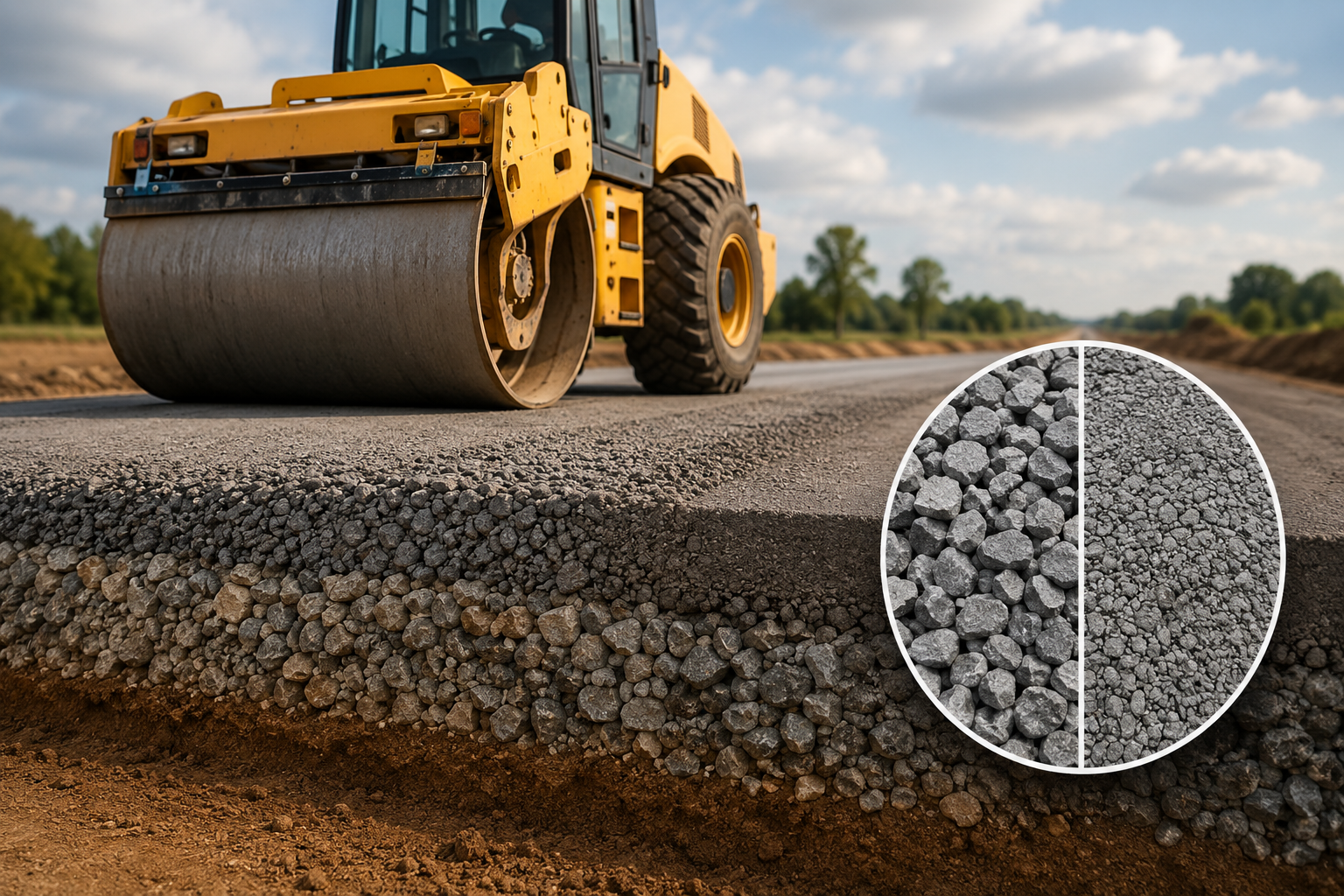
When a road starts cracking or sinking within a few years of being built, the finger usually points at the surface. Bad asphalt, cheap sealant, and weather. Rarely does anyone ask what was happening three or four inches below that surface during construction. That is where the real decisions get made. The way road base material gets compacted or doesn't set the trajectory for everything that comes after. At Western Materials, we've seen firsthand how proper compaction can make the difference between a pavement that lasts and one that fails prematurely.
This blog breaks down what compaction actually does to base performance, what goes wrong when it is handled poorly, and why the material you start with matters just as much as the equipment pressing it down. If you are sourcing road construction materials for any kind of paving project, this is worth understanding before the first roller passes.
What Compaction Is Actually Doing Down There
A pile of crushed aggregate looks solid, but it is mostly air. All those gaps between particles add up, and that void space is the enemy of a stable road structure. Compaction drives that air out. As the material gets worked, the particles shift and push against each other until they are interlocked rather than just stacked. Once that happens, the material starts behaving like a unit instead of a collection of loose pieces.
The practical result is better load transfer. A well-compacted road base spreads the weight of a vehicle across a broad footprint before it reaches the subgrade underneath. Without that spread, loads punch straight down, and the subgrade soil deforms. That deformation slowly climbs upward through the layers and eventually shows up at the surface as rutting, cracking, or sinking. A stiff, dense base prevents that entire sequence from starting.
There is another side to this that does not get mentioned as often. Under repeated loading, material that was not properly locked together tends to creep sideways. It migrates gradually, and when it does, the road loses the support it was designed to have. Proper compaction keeps everything in place laterally, not just vertically.
The Numbers That Drive Compaction Decisions
Engineers measure compaction by comparing field density to the maximum density achievable in a laboratory under controlled conditions. That ratio, expressed as a percentage, tells you how close the material in the ground comes to its theoretical best. Road base specifications typically call for somewhere between 95 and 100 percent of that lab maximum.
Falling a few points short has consequences that are far more serious than most people realize. Studies in pavement engineering consistently show that a base compacted to 90 percent rather than 95 percent can cut the pavement's useful life by 30 to 40 percent under normal traffic. That is not a rounding error. It means spending on repairs a decade earlier than you should have.
Moisture is half the battle here. Every aggregate material has a specific moisture level at which it responds best to compactive effort. At that moisture content, particles can shift and seat against each other without resistance. Too dry, and the material fights back. Too wet, and the water acts as a buffer that keeps particles from making proper contact. Field crews often test moisture before compaction begins precisely because hitting that window determines whether the effort spent actually translates into density.
The right moisture content and aggregate gradation can make all the difference when it comes to achieving target compaction.
Request a Material Quote
How the Base Connects to Pavement Life Above It
The asphalt or concrete layer sitting on top of a road base does not carry loads alone. The whole thing works as a layered system, and the base contributes stiffness that the surface layer depends on. Engineers use a measurement called resilient modulus to describe how a base material recovers after being loaded. A well-compacted crushed stone road base can have a resilient modulus two or three times higher than the same material in a poorly compacted state.
More stiffness means less deflection each time a tyre passes over. Less deflection means the asphalt above it bends less. And every time asphalt bends, it accumulates fatigue. Reduce the bending, and you dramatically extend how long the surface holds together before cracking begins.
Uneven compaction creates a specific problem that is arguably worse than compaction that is uniformly low. When adjacent sections of base are compacted to different densities, they settle at different rates. The pavement cracks at those boundaries. Once a crack opens, water gets in. Water weakens the base. A faster failure cycle follows. This is why compaction testing happens at intervals across a project rather than at a single convenient point.
Conclusion
Proper compaction is critical to long-term pavement performance, but even the best equipment can only do so much if the material itself is not up to the task. Well-graded, high-quality aggregates create a stronger, more stable foundation that supports density, load distribution, and pavement longevity.
At Western Materials, we supply road base materials engineered to meet ASTM, Caltrans, and Greenbook standards, helping contractors build durable pavement systems from the ground up.
Build a stronger pavement foundation with road base materials that meet ASTM, Caltrans, and Greenbook standards.
Check Material Availability
FAQs
What is the recommended compaction level for road base material in road construction?
Most road construction specifications call for the road base material to reach a minimum of 95 percent of maximum dry density, as measured by Proctor testing. For high traffic corridors or routes that carry heavy axle loads, they often want 100 percent. That goal has to be hit consistently over the entire footprint of the base, not only at a few checked spots. Western Materials supplies aggregate base course products with the gradation needed to support those compaction targets, in a dependable way.
How does moisture content affect road base compaction?
Every aggregate base course material has an optimum moisture content, a specific range where particles respond most readily to compactive force. Below that range, the material resists densification. Above it, particles cannot seat properly, and the water acts as a barrier to interlocking. Getting moisture content right before and during compaction is standard practice on well-run projects, and it makes a measurable difference in the density actually achieved.
Can poor road base compaction cause surface cracking even on new roads?
It can, and it happens regularly. When base course compaction is inadequate, the base continues consolidating under traffic after the road opens. That post-construction movement is uneven, which causes the asphalt above to crack at points of differential settlement. Those cracks let water into the base, which accelerates softening and leads to further cracking. Compacting the base properly during construction breaks that cycle before it starts.
What types of crushed stone road base compact best for flexible pavement foundations?
An angular, well-graded crushed stone road base is the standard choice for flexible pavement foundations. Angular particles interlock under compaction and resist lateral movement under load. A well-graded gradation, one that includes a controlled spread of particle sizes, fills voids efficiently, and supports a higher achievable density than single-sized material. A rounded aggregate cannot replicate that interlocking behaviour regardless of how much compactive effort goes into it.
How often should compaction testing be done during road base construction?
Most specifications usually ask for testing every 500 to 1,000 square feet of compacted base, though the exact interval kinda shifts based on the jurisdiction and the project type. It’s also smart to test whenever there’s a change in material or equipment, or when site conditions get different. Doing just one test in a single location isn’t really enough. What really controls whether the road ends up running evenly and how long the foundation materials survive under actual traffic loads is consistent compaction across the whole base area.
.avif)
Materials management and founders
have produced and supplied high quality
sand and gravel to contractors &
aggregate users across California.
.svg)
.svg)


